
You can style a bed in under a minute with nothing but sleeping pillows stacked two by two, or build a nine-pillow hotel stack that costs an hour each morning to reset. The variation that actually changes your life is not which look you pick, but whether your bed gets used for sleeping or for staging a guest room.
The mistake people make is buying Euro shams first. They are decorative only, and at 26 by 26 inches they eat storage space you do not have. Start with the sleeping pillows you already need, add the Euro shams only when you find a set on sale, and build forward from there.
1. Clean and Simple
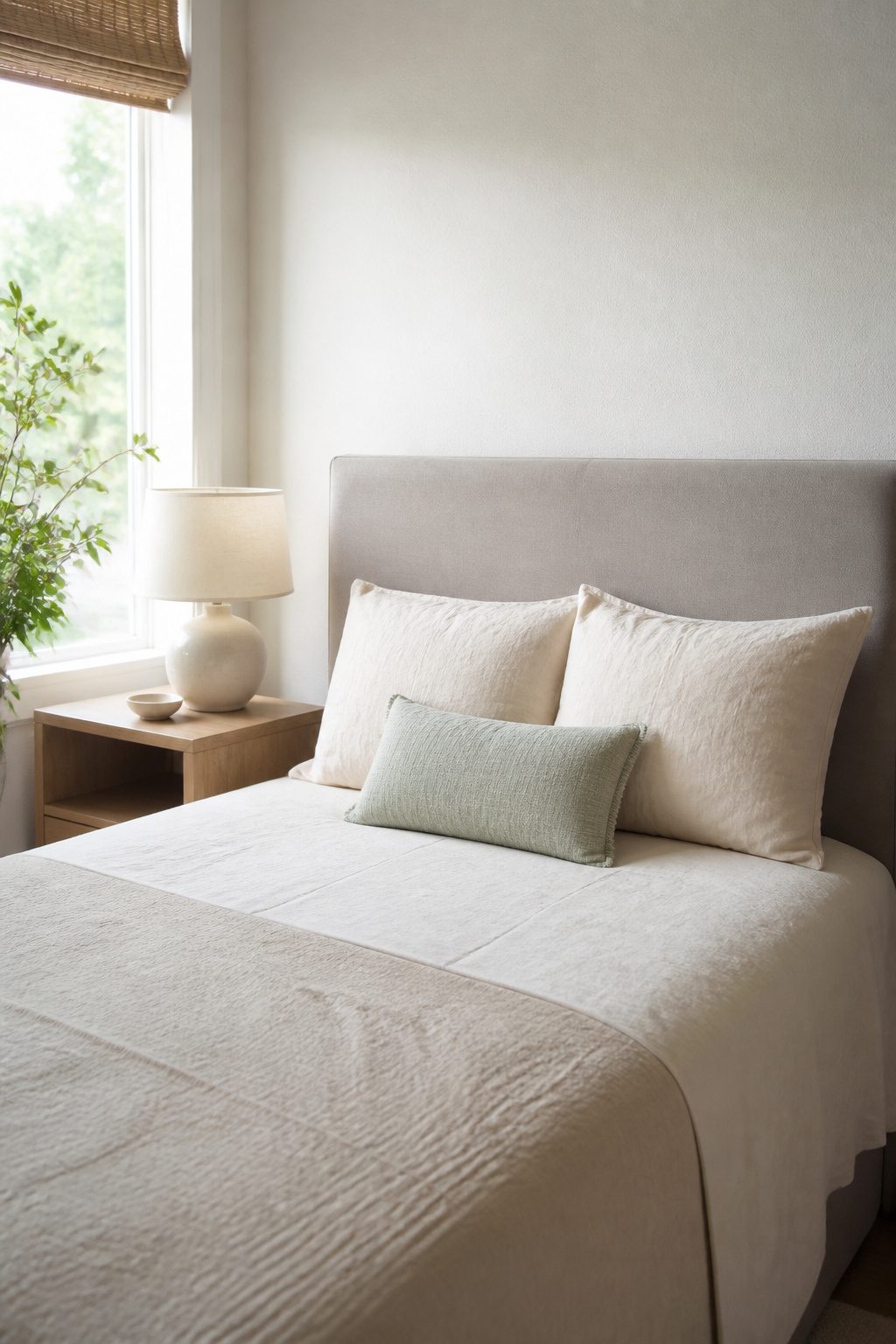
Two sleeping pillows side by side, flush with the headboard, is the arrangement I keep coming back to when I want the bed to look finished without adding more to move later. On a twin, a single pillow centered reads the same way; on a queen or king, the pair fills the width without crowding the mattress. The sources agree that one row of pillows works for twin beds, while wider frames need the side-by-side pair to balance the space.
What makes this worth keeping for renters is the math of packing. Sleeping pillows travel in the bedding bin. Add even one accent pillow and you gain a look, but you also gain a loose item that needs its own cover, its own spot in the truck, its own decision at the next apartment. I leave the accent off more often than not, and the bed still looks intentional.
A single lumbar in front of the sleeping pair is the restraint I use when I want something. The linen cover stays tucked just below the pillows, same shade as the sheets, and the whole thing takes under a minute to reset in the morning.
2. Stacked and Propped
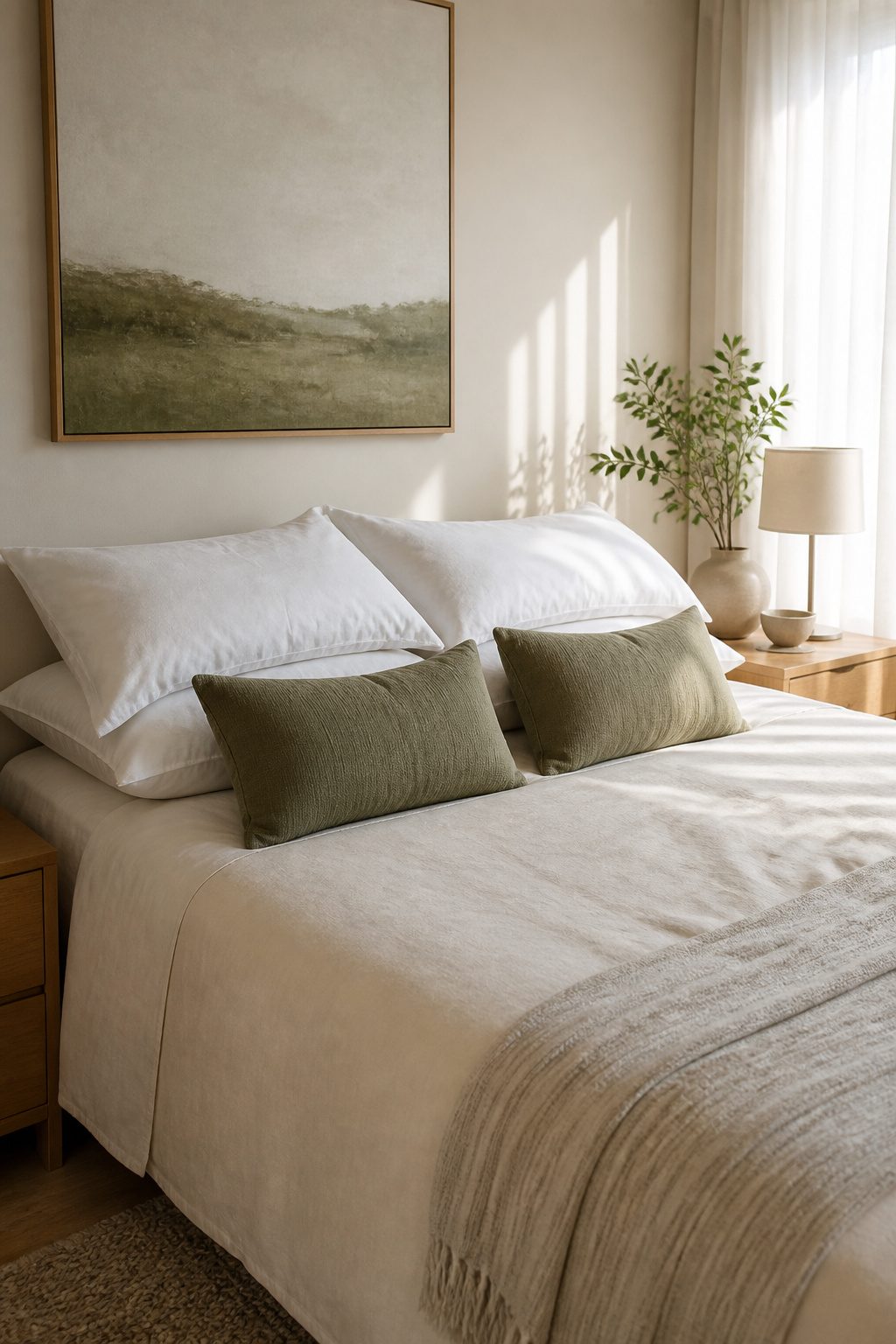
Four sleeping pillows stacked in two piles of two builds a backrest that costs nothing extra if you already own them. Standard pillows run 20 by 28 inches, and two deep stacks give you nearly the same height as Euro shams without the specialty covers. I tried this on a queen bed last winter after my Euro shams shrank in the wash. The stacks sat flat against the headboard and the pillows stayed put better than singles leaning there.
Two small lumbar pillows propped in front finish the look. They do the actual decorative work, so the sleeping stacks can stay plain white or match your sheets. The gap between the two stacks is where the arrangement either looks intentional or accidental. Push the stacks close enough that the lumbar pillows bridge them visually, but leave an inch or two of breathing room so the front edge stays straight. Too tight and the lumbar pillows bow forward; too loose and the stacks read as two separate beds shoved together.
3. Layered Neutrals
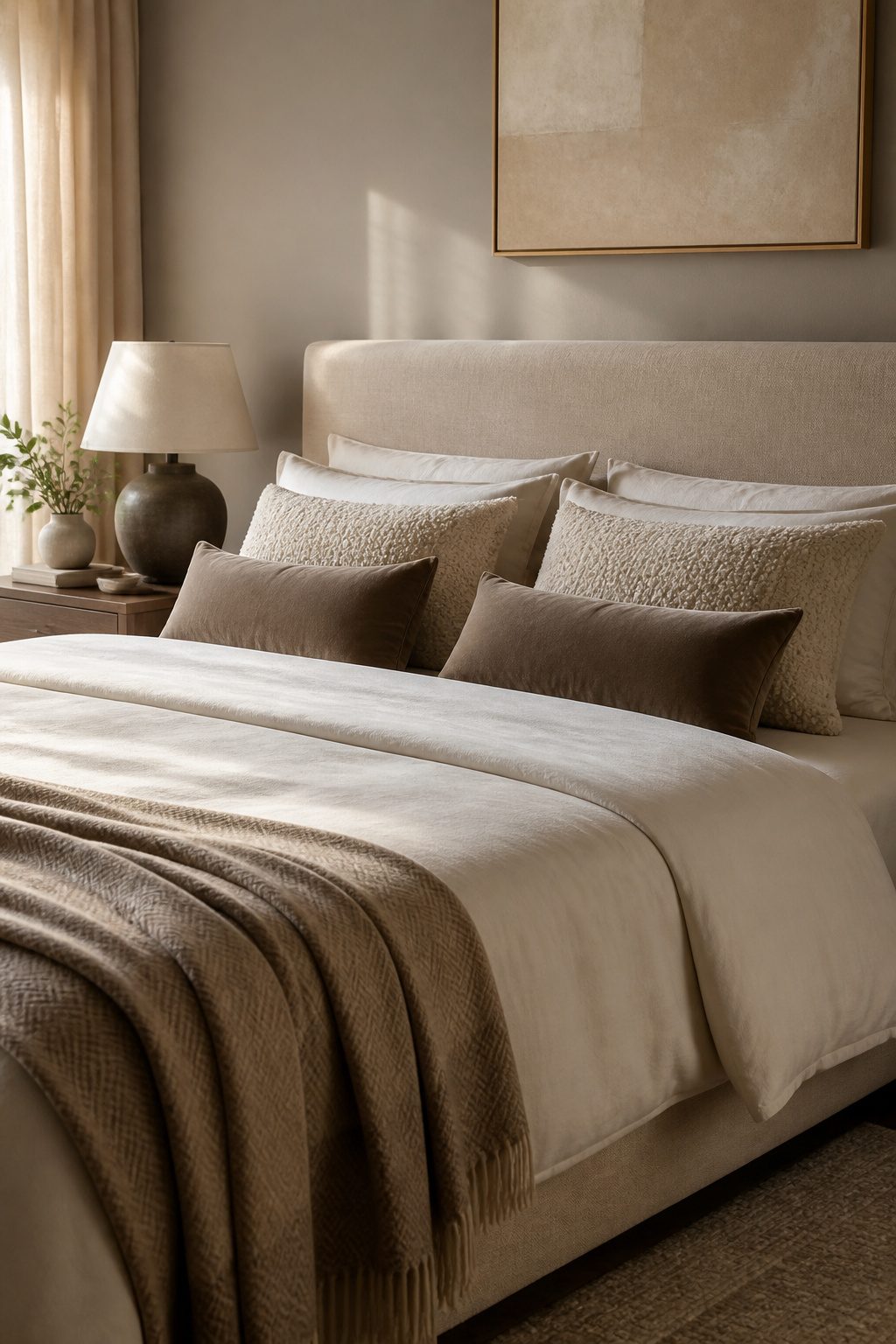
Two neutral sleeping pillows propped against the headboard, then a textured lumbar pillow in front of each. That is the whole arrangement, and it works because the texture does the job color usually does.
Boucle reads polished without trying, and it holds up to weekly use better than you might expect. The nubby weave hides the flattening that smooth fabrics show after a few nights of leaning against them. Velvet gives you a different kind of depth, something closer to shine, and a metallic tone like gold or champagne against quiet neutrals adds that glamour without tipping into flashy. Linen and cotton weaves mixed in keep the bed from feeling too staged, too finished.
The mistake I see is picking one texture and repeating it everywhere. A slipcovered bed with boucle lumbars works because the base is plain and the pillow is doing the work. If the base is already textured, the lumbar should be smoother, or the whole thing starts to compete with itself.
Leather is the outlier here, and sometimes the right one. A leather lumbar adds richness without prints or tassels, and it ages the way denim does, picking up marks that read as character rather than wear. Not for every bed, but for the ones that feel too soft already, it grounds the look.
What holds up to weekly use: boucle for hiding wear, linen for getting better as it softens, velvet if you rotate which side faces out. Satin against fluffy shams gives you depth, but the satin side shows oil faster, so keep it to the decorative layer, not the one you sleep on.
4. Luxe Layers
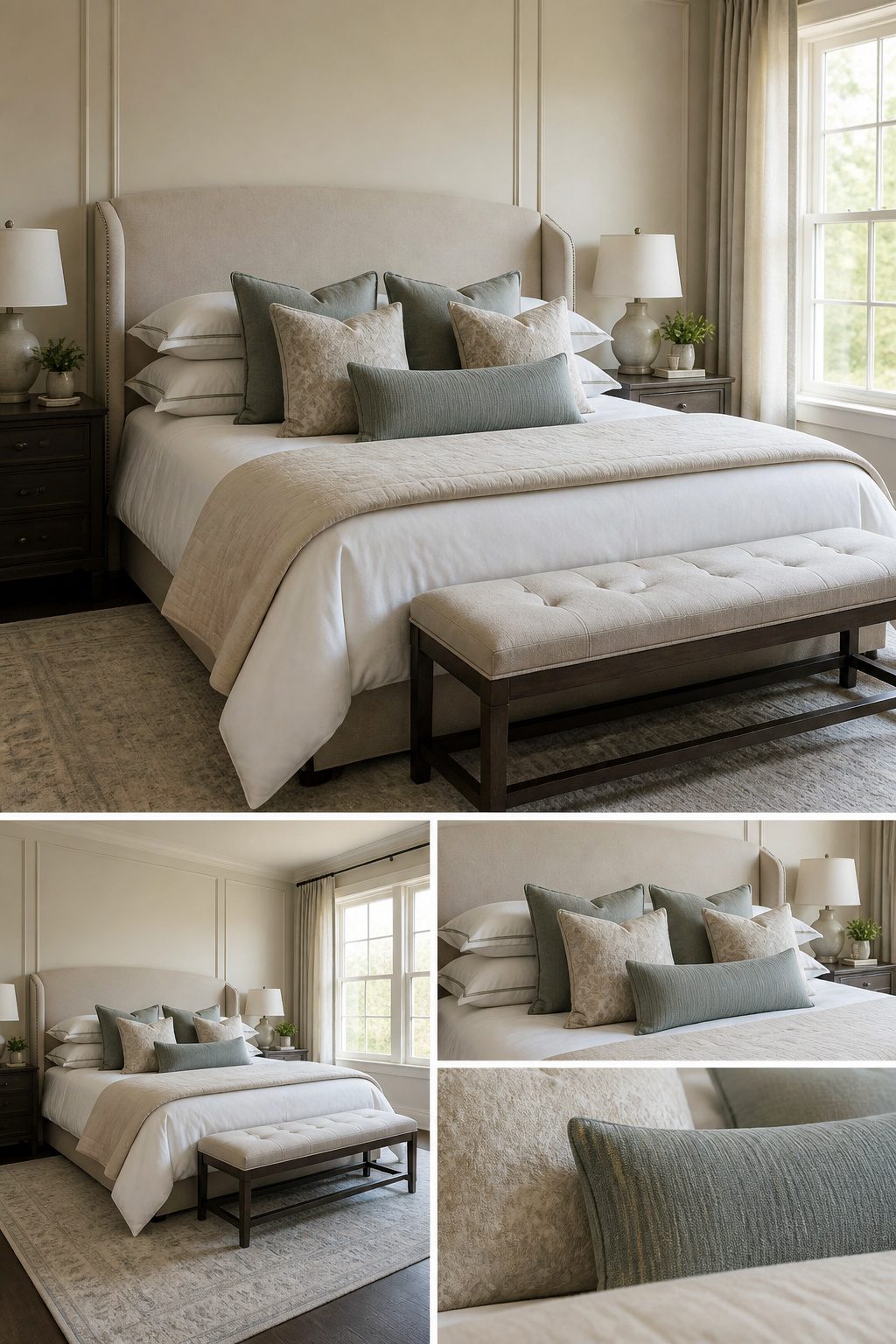
The luxe build starts with four standard sleeping pillows, two stacked on each side, then two 26-by-26-inch Euro shams standing upright against the headboard. Two 20-inch square pillows sit in front of those, and one long lumbar finishes the row. That is nine pillows total, which sounds excessive until you see how the back layers frame the smaller ones so nothing reads as clutter.
Euro shams are decorative only; standard pillows do the actual sleeping work. I would buy the sleeping pillows first, since you already need them, then add the Euro shams when you find a set on sale. The squares and lumbar come last. Queen beds look best with three to five decorative pillows total; a king takes five to seven, so this full build really only suits a king or an especially wide queen where you have the surface to spare.
The symmetry is forgiving on color and pattern mixing because the matching back rows anchor whatever you do in front. If the cost of nine new pieces stings, start with just the two Euro shams and the lumbar. You still get the layered look without the full investment.
5. Asymmetrical Elegance
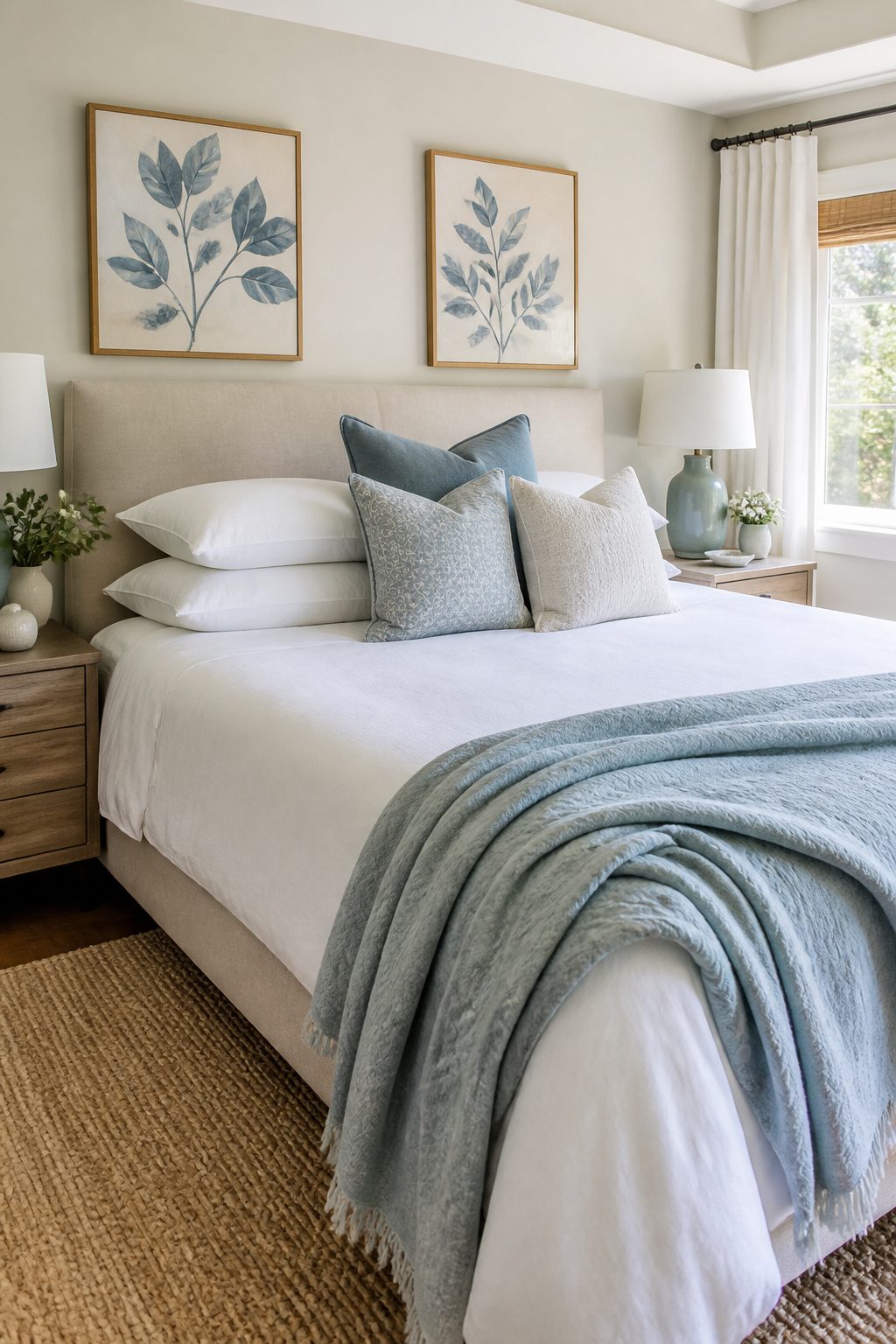
Asymmetry reads creative and relaxed, but the line between creative and unfinished is thin. The trick is a tight color palette: same family, two or three colors at most, with enough tonal range to let the mismatched sizes and prints feel intentional rather than random.
I start with two standard sleeping pillows stacked, then layer four or five accents in different sizes: one 26-inch square, two 22- or 24-inch squares, one 20-inch square, and a lumbar. The odd numbers help the relaxed look. What holds it together is keeping everything within one color family, say soft sky blues through deep navy, so the variation in scale and pattern reads as design, not clutter.
One oversized pillow in a bold color or print can anchor the whole arrangement and set the palette for everything around it. Echo those colors elsewhere in the room, in artwork or a throw, so the bed feels connected to the space rather than dropped into it.
6. Hidden Stack
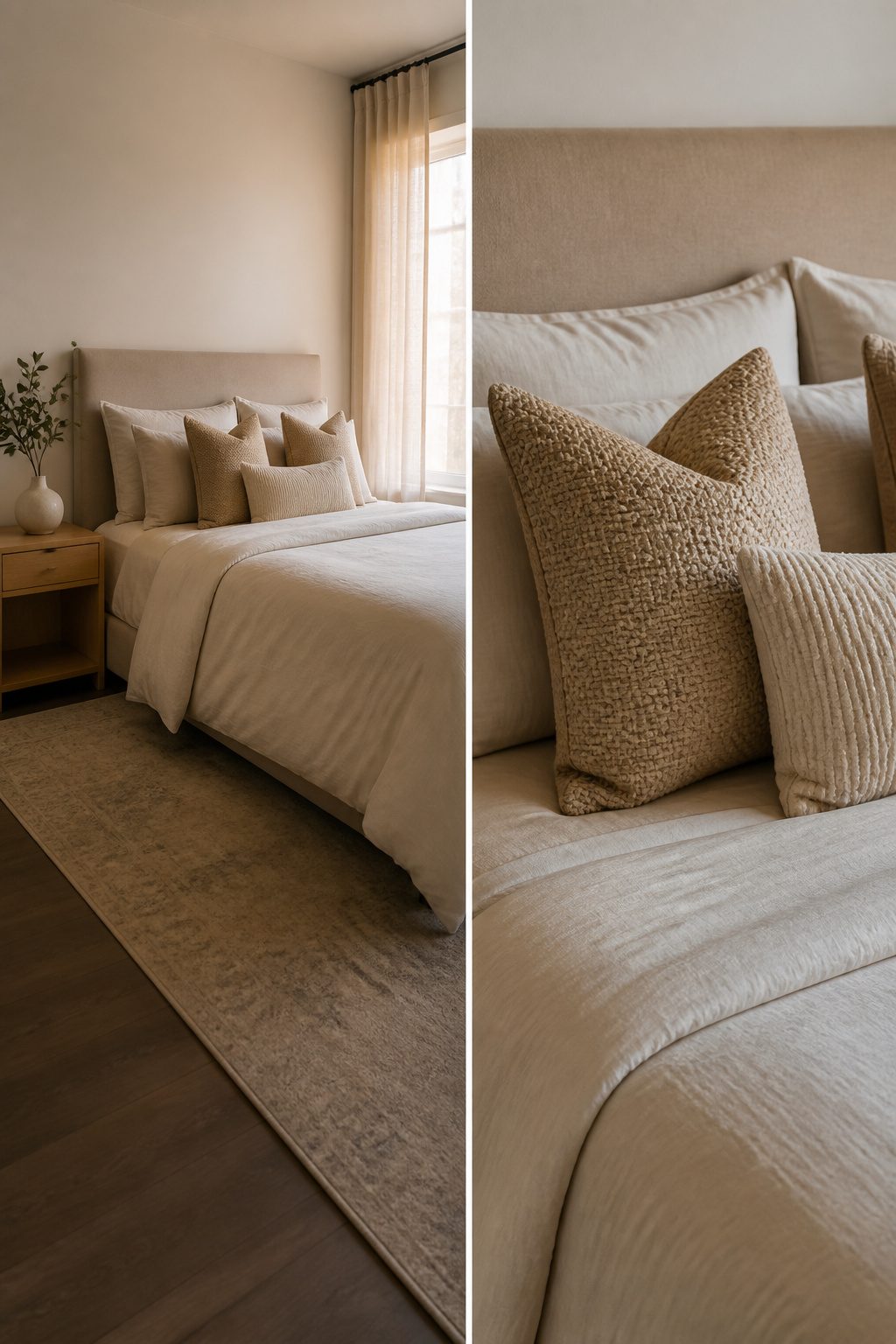
The hidden stack works because the back pillows disappear. You place your sleeping pillows in standard shams against the headboard, then stand a second layer in front so only the front faces show. That front layer reads as the whole arrangement, which is the point.
For twin beds, decorative pillows in front keep the scale right; king beds can take euro squares without looking crowded. Full or queen size beds leave room for either. The back pillows should share one color so they read as a solid block, while the front layer carries the contrast or texture you actually want to see.
At night the front pillows move. I keep a basket at the foot of my bed for the decorative layer, though the euro-size front pillows on a king can just get stacked flat and out of the way. The sleeping pillows stay put; you only handle the ones that were doing the visual work.
7. The Classic Look
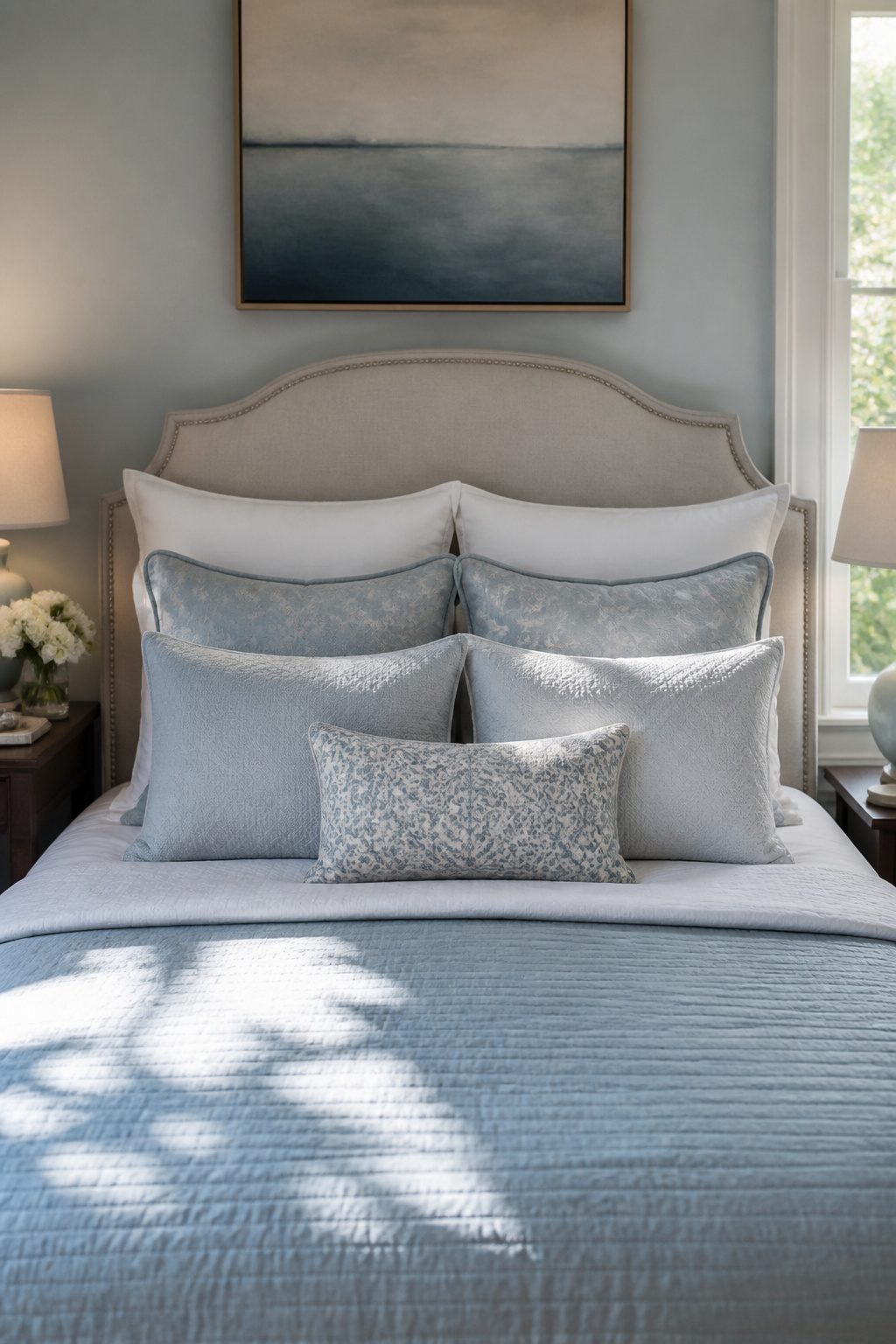
The classic build starts with two standard sleeping pillows standing upright against the headboard, then two 26-inch Euro shams, then two 20-to-22-inch standard shams, and finally one smaller pillow centered in front. Each layer steps down in size so nothing hides what sits behind it.
Euro shams work here because their square shape holds a crisp vertical line against the headboard, while standard sleeping pillows stay flat for actual sleep. On a queen bed, this seven-pillow formula reads as intentional without crowding the mattress. For a king, the same proportions hold but the width lets the layers breathe.
What convinced me, reading through a dozen of these arrangements, is that the centered front pillow does the heavy lifting. Swap a 20-inch embroidered medallion for a lumbar and the whole bed shifts mood without touching the back row. The two 26-inch and two 20-to-22-inch pillows stay constant; the small front pillow is where you experiment.
8. The Minimalist Look
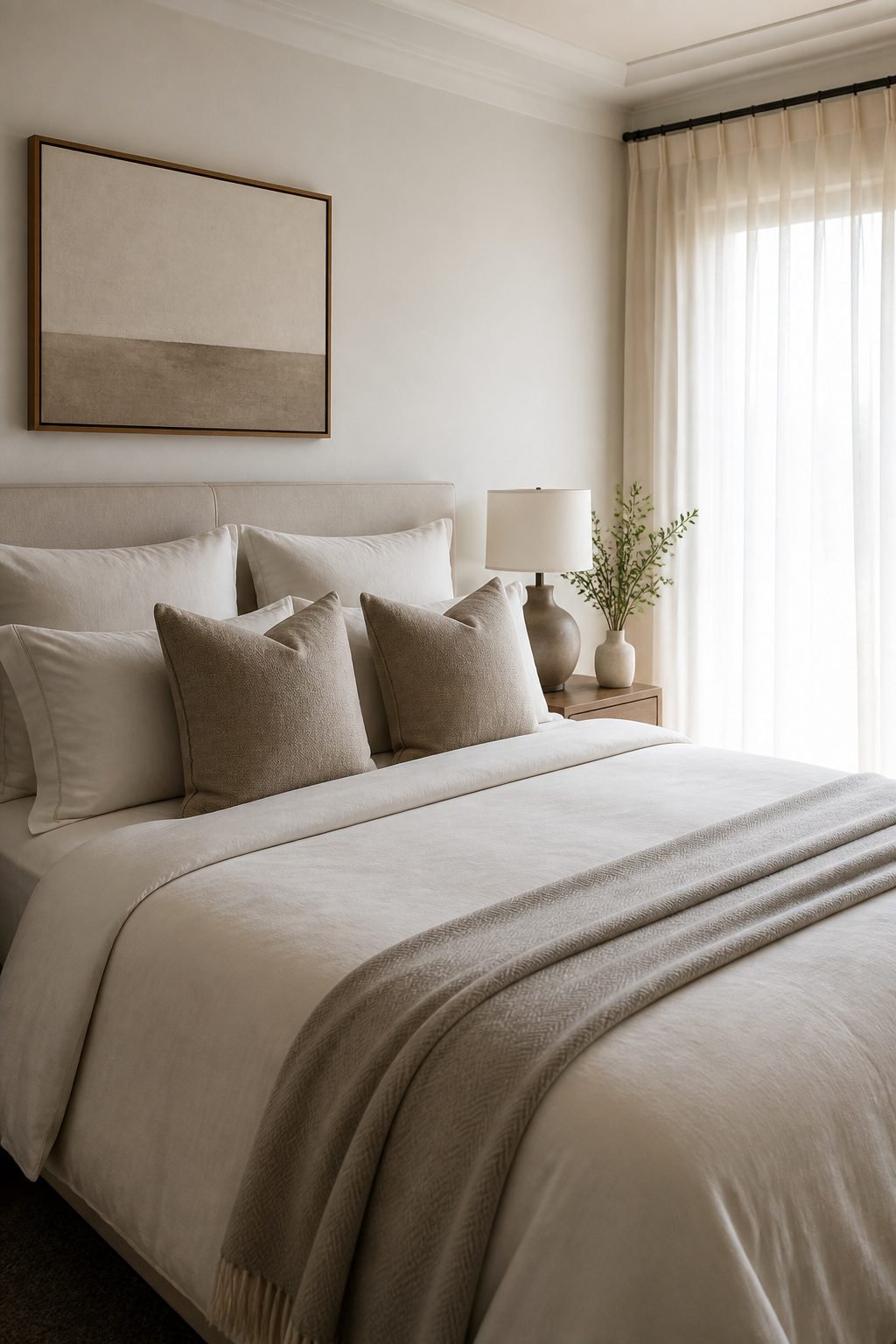
The minimalist look runs on six pieces instead of the usual tower of pillows, and each one has to earn its place. Two bed pillows lean upright against the headboard, two standard shams layer in front of them, and two decorative pillows finish the row. A pair of 26-inch decorative pillows fills a taller headboard without looking swallowed; scale down to 20 inches if the headboard sits lower or the room itself is small. That front pillow pair does the visual work that a larger stack would, so fabric choice matters more here than in busier arrangements. Solid textures or a quiet weave read as intentional rather than bare. I have seen this formula go flat when the shams and the decorative pillows share the same fabric weight; the bed ends up reading as four identical lumps. A lighter sham against a denser decorative front, or the reverse, gives the eye something to travel across without adding pieces.
9. The Practical Look
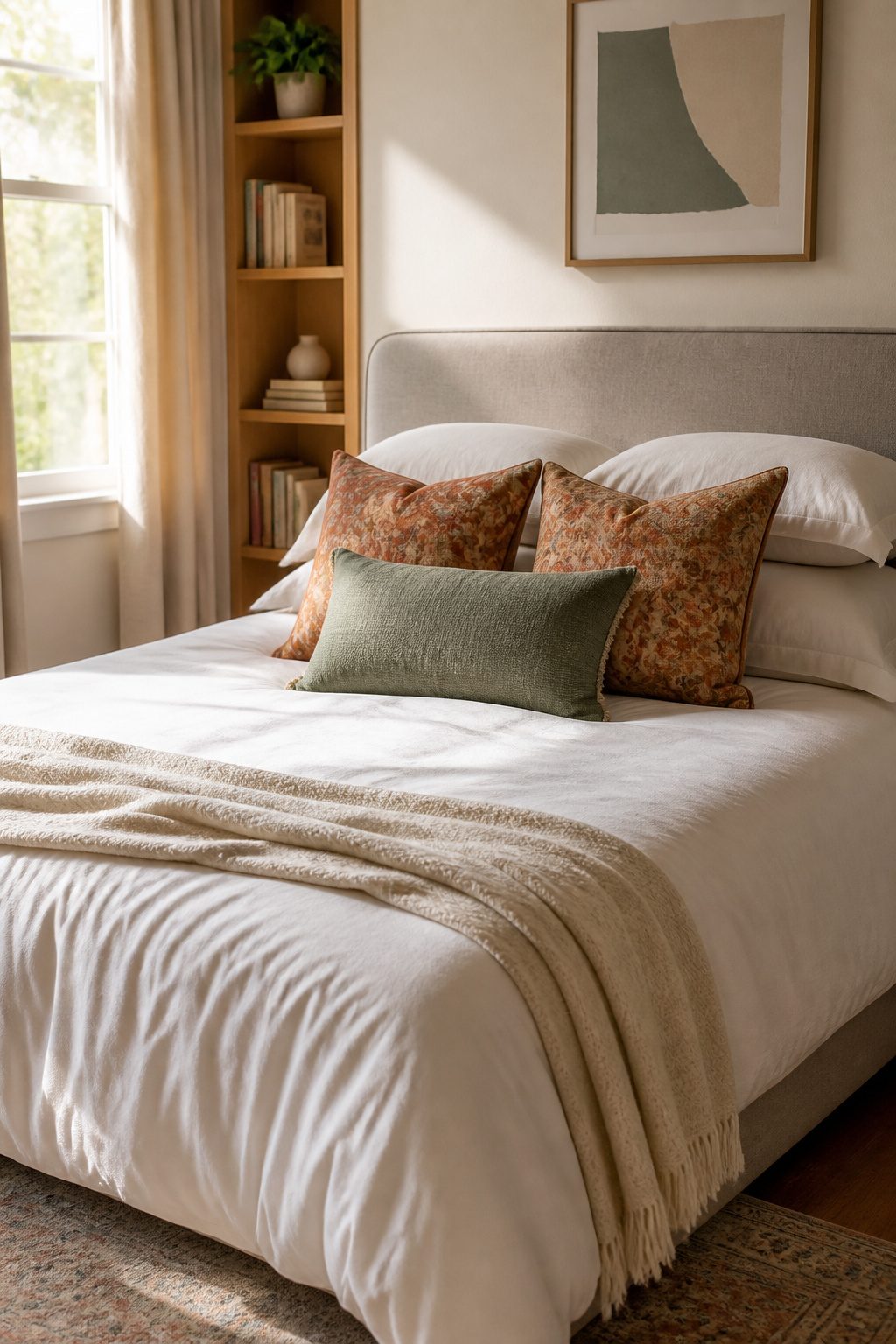
The practical look starts with four sleeping pillows stacked in pairs against the headboard, then two 22-by-20-inch decorative pillows and one 18-to-20-inch pillow layered in front. Every pillow you own stays on the bed, so nothing gets stuffed into a closet or under the frame.
Two stacks of two sleeping pillows each fills the width of a queen without looking sparse. The front trio gives enough structure to read as styled from the side, which is where most bedrooms get viewed anyway. Patterned pillowcases and a patterned top sheet work well here, since the fuller layout already carries enough visual weight to balance them.
For anyone who actually uses four pillows to sleep, or shares a bed with someone who does, this is the arrangement that does not ask you to rotate decorative sets in and out. It also skips the storage problem that comes with owning pillows you only display.
10. The Maximalist Stacked Layers
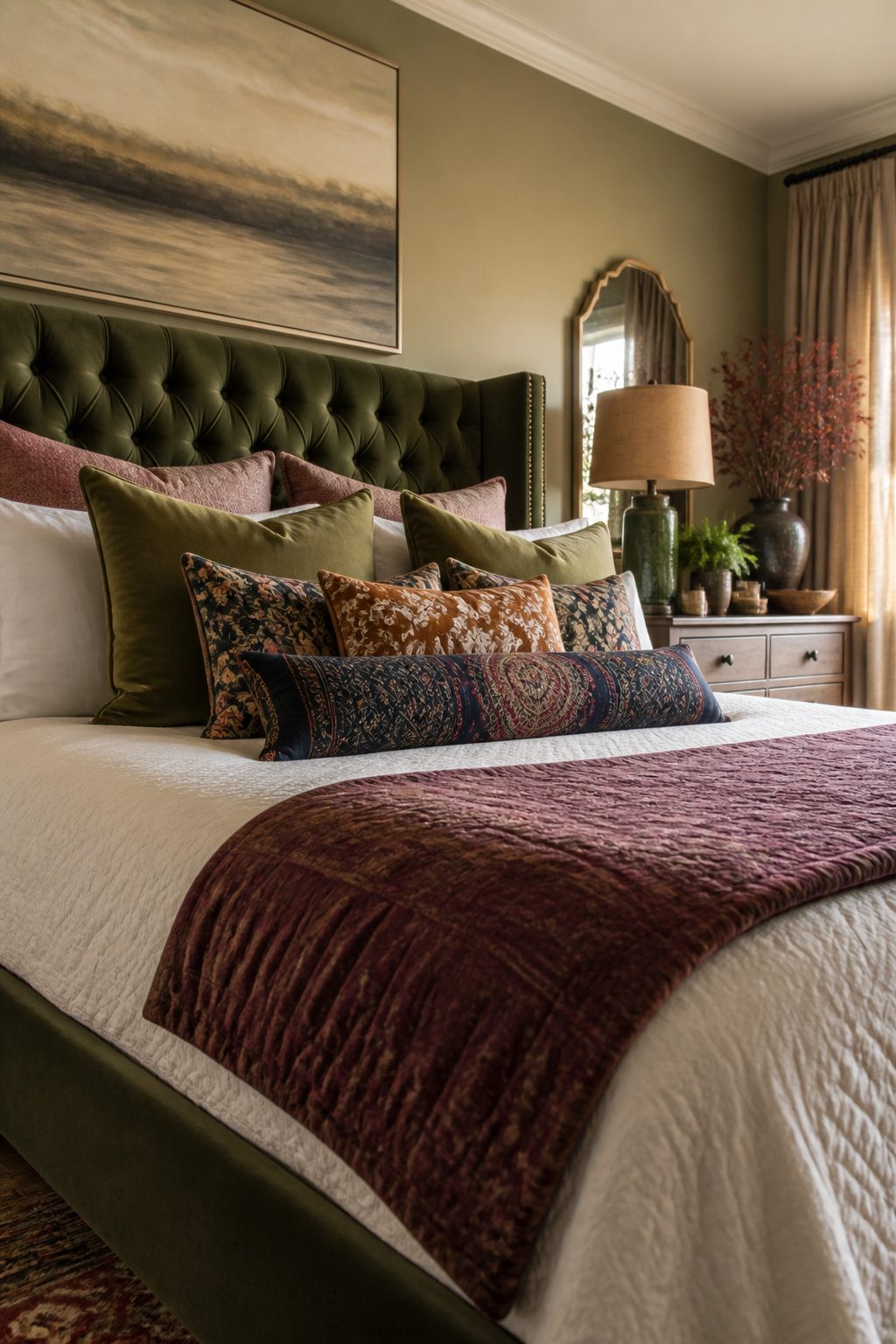
The maximalist stack starts with your sleeping pillows against the headboard, then builds forward in tiers. Two standard pillows go in back, followed by two or three Euro shams standing upright, then another row of standards or up to four decorative squares, and finally a single lumbar pressed flat at the front edge. A queen bed needs three to five decorative pillows; a king needs five to seven to keep the proportions from looking sparse against the wider mattress.
With this many layers, contrast becomes the workhorse. Alternate colors, textures, or patterns between each row so the eye can separate them without reading the bed as a single block. A monochromatic scheme only survives here if every layer carries a different weave or finish, like velvet against linen against a nubby cotton.
The full build gets heavy fast. I count four distinct rows once everything is in place, which is enough height that shorter sleepers may find the front pillows end up on the floor by morning. For a guest room or any bed that actually gets used daily, the minimal three-pillow formula, two squares and a lumbar, keeps the look without the reset time.
11. Peekaboo Color
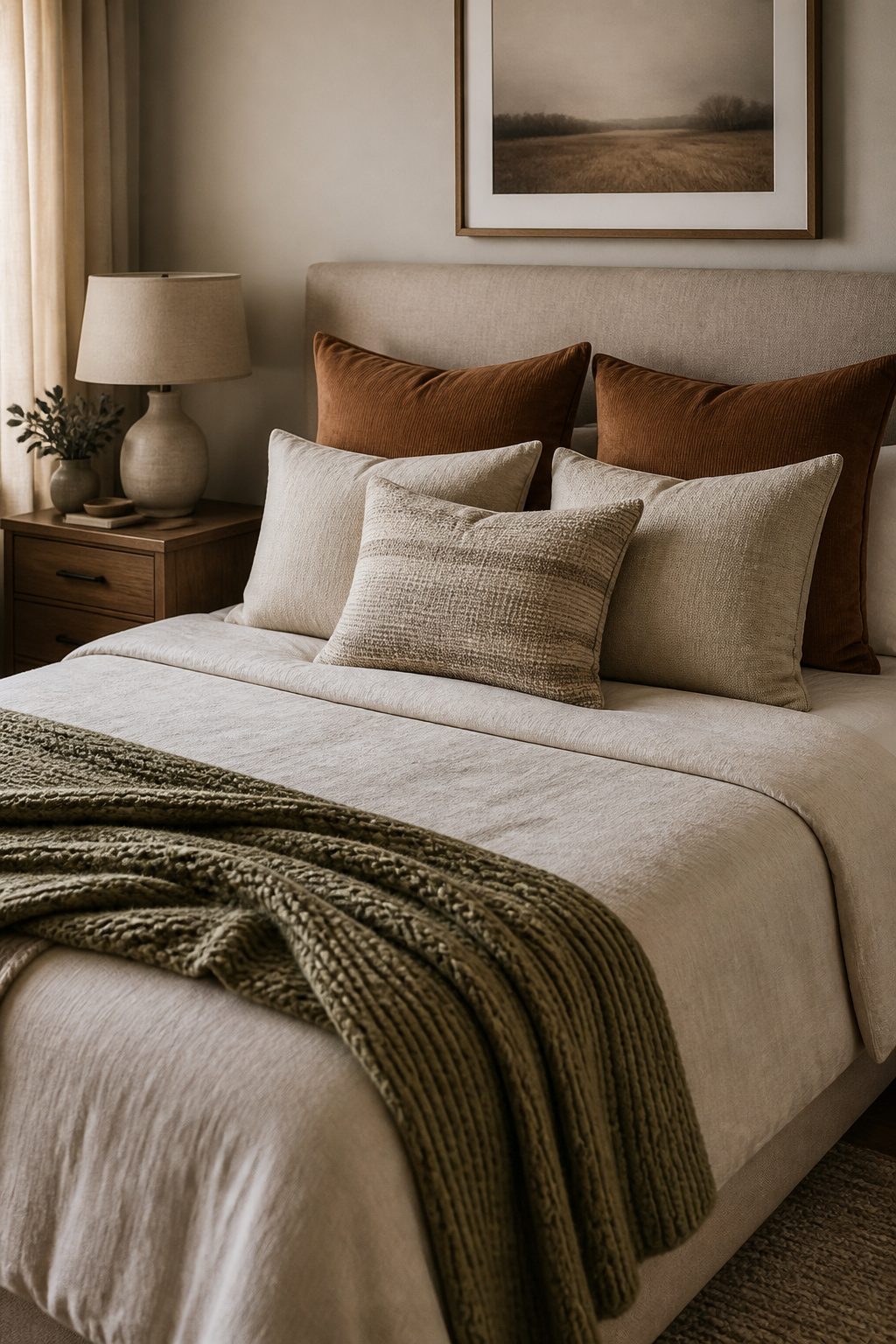
The peekaboo trick works best when the color reads as intentional, not like a pillow that slid backward and got forgotten. Two 20-inch Euro shams in something bold, tucked behind three 18-inch Euros in front, give you just the edge showing. That proportion matters: roughly one-third of the back pillow stays visible, enough to register as a frame, not enough to compete with what’s in front.
A neutral bed can handle the contrast. Rust tones, a dark floral, even a saturated solid, all read as designed when the palette stays tight. Keep it to two or three colors that already exist in the room, repeated somewhere else, and the bed feels connected rather than staged. The mistake is using too many competing brights, where the eye can’t tell what was planned and what was left over from another project. One bold layer behind, one quieter story in front, and the peekaboo lands exactly where it should.
12. Effortless Minimalism
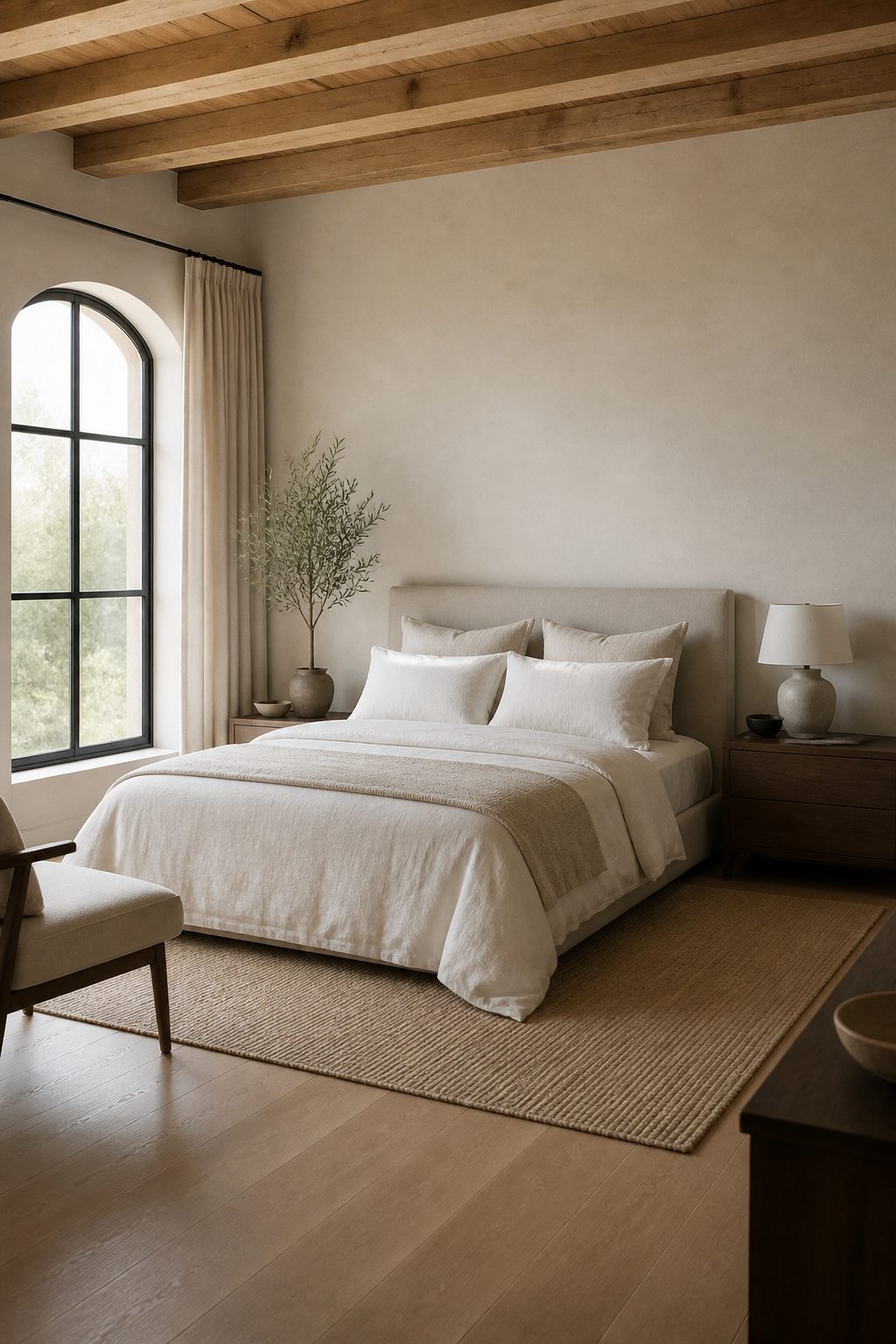
Leaning pillows against the headboard sounds easy until one slips sideways at 2 a.m. and the whole row collapses. The trick is knowing which fills stay upright and which surrender to gravity.
Euro shams at 26 by 26 inches hold their shape because the square form has no long edge to fold. Standard sleeping pillows at 20 by 28 inches work too if the fill is firm, but cheaper polyester or down-alternative ones gradually slump into a valley. Two Euro shams plus two standards in front gives you the structure without the stack. Skip the lumbars here; they are built for lower back support, not vertical propping, and tend to pancake against a headboard when stood on end.
Linen pillowcases help more than you’d expect. The fabric has enough grip to keep the line from sliding, and the rumpled texture reads as intentional rather than messy. Four standards leaned vertically, two smaller pillows in front, and nothing behind them but the headboard itself. That is the whole arrangement. It takes thirty seconds and looks like you meant it, which is the point of minimalism done right.
13. Hotel-Inspired
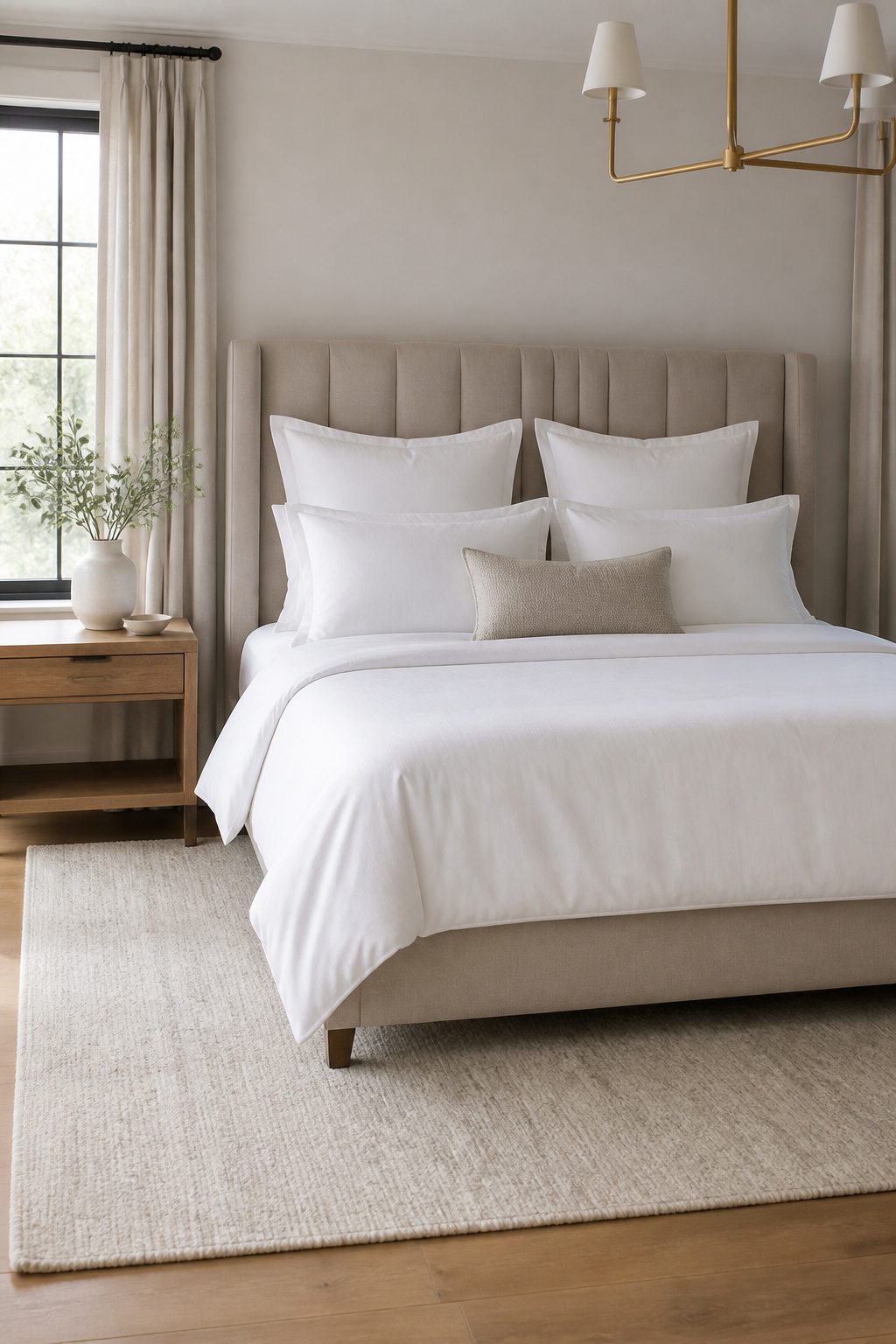
Crisp white Euro shams stacked against a headboard read as instant calm. The trick is keeping them actually white, not the color of last week’s moisturizer.
Two king sleeping pillows go vertical against the headboard, then three crisp white Euro shams in front. A single 20-inch accent pillow in front of that row gives the eye one place to land. White-on-white base, one point of contrast. The sources that rank for this agree on the stack height; they split on whether to center the accent or offset it slightly, and either works if the sham line stays straight.
White pillowcases need washing every seven to ten days, not the two weeks most people stretch sheets to. Body oils travel upward. I buy shams with envelope closures so the insert doesn’t peek out after the third wash, because a visible zipper undoes the whole hotel fantasy in about two seconds.
14. Pattern Play
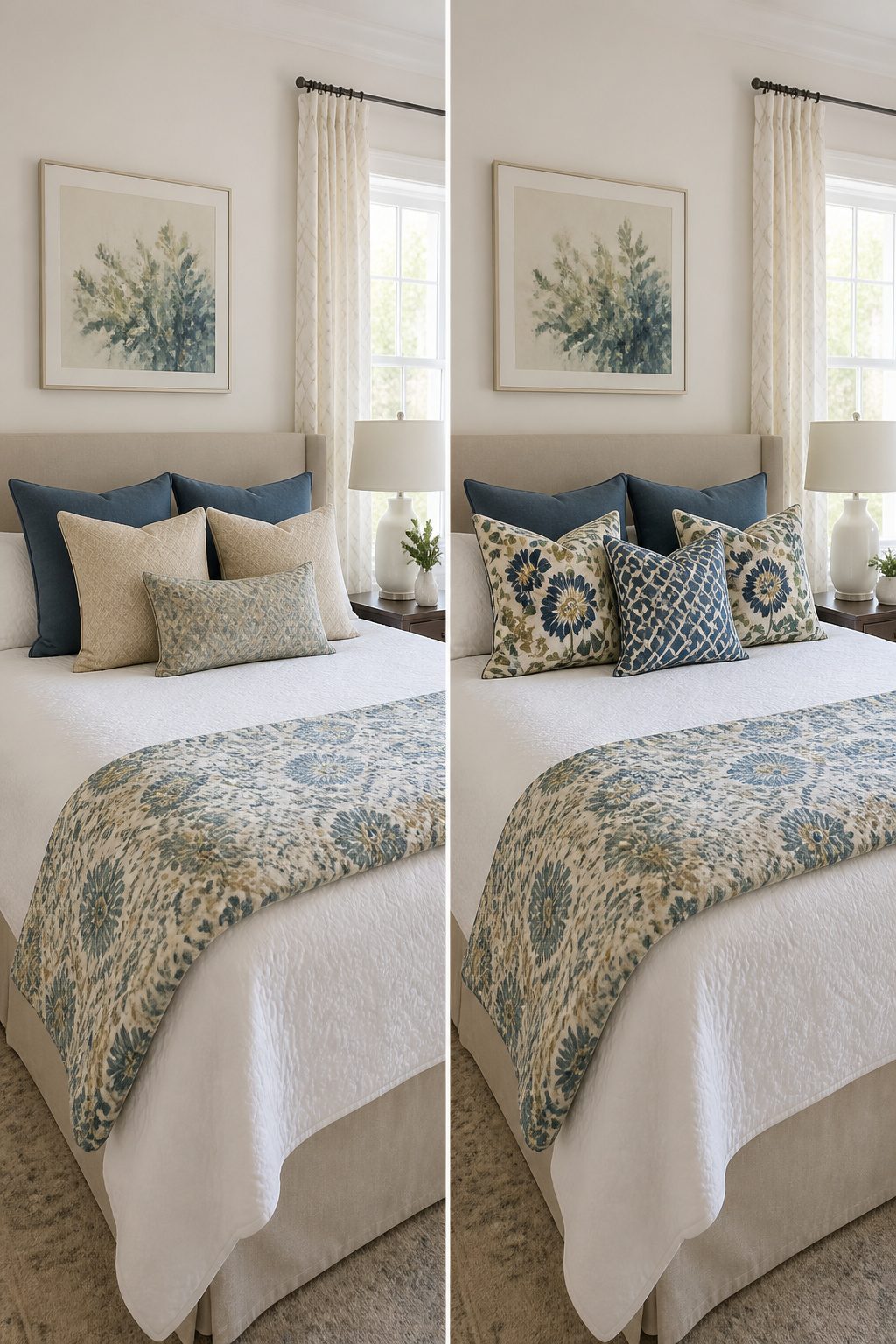
Pattern play on a bed works best when you treat the rule of three as a hard limit, not a starting suggestion. Three decorative pillows in front of your sleeping stack gives the eye a place to rest; add a fourth and the arrangement starts competing with itself. Two of those three can share a pattern and a 22-by-22 inch size, while the third, smaller and rectangular, carries the contrast.
The trick to mixing prints without chaos is scale variation: pair a large floral or stripe with a medium-scale geometric, then anchor them with a small repeat or solid in a coordinating color. Keep everything in the same color family so the patterns read as intentional rather than accidental. On a queen bed, three to five decorative pillows is the workable range; a king can take five to seven, but the same rule of three still governs the front layer where the patterns actually show. Overlap them slightly, largest in back to smallest in front, so each fabric gets its moment without sitting side-by-side like a catalog spread.
15. Layered Leather
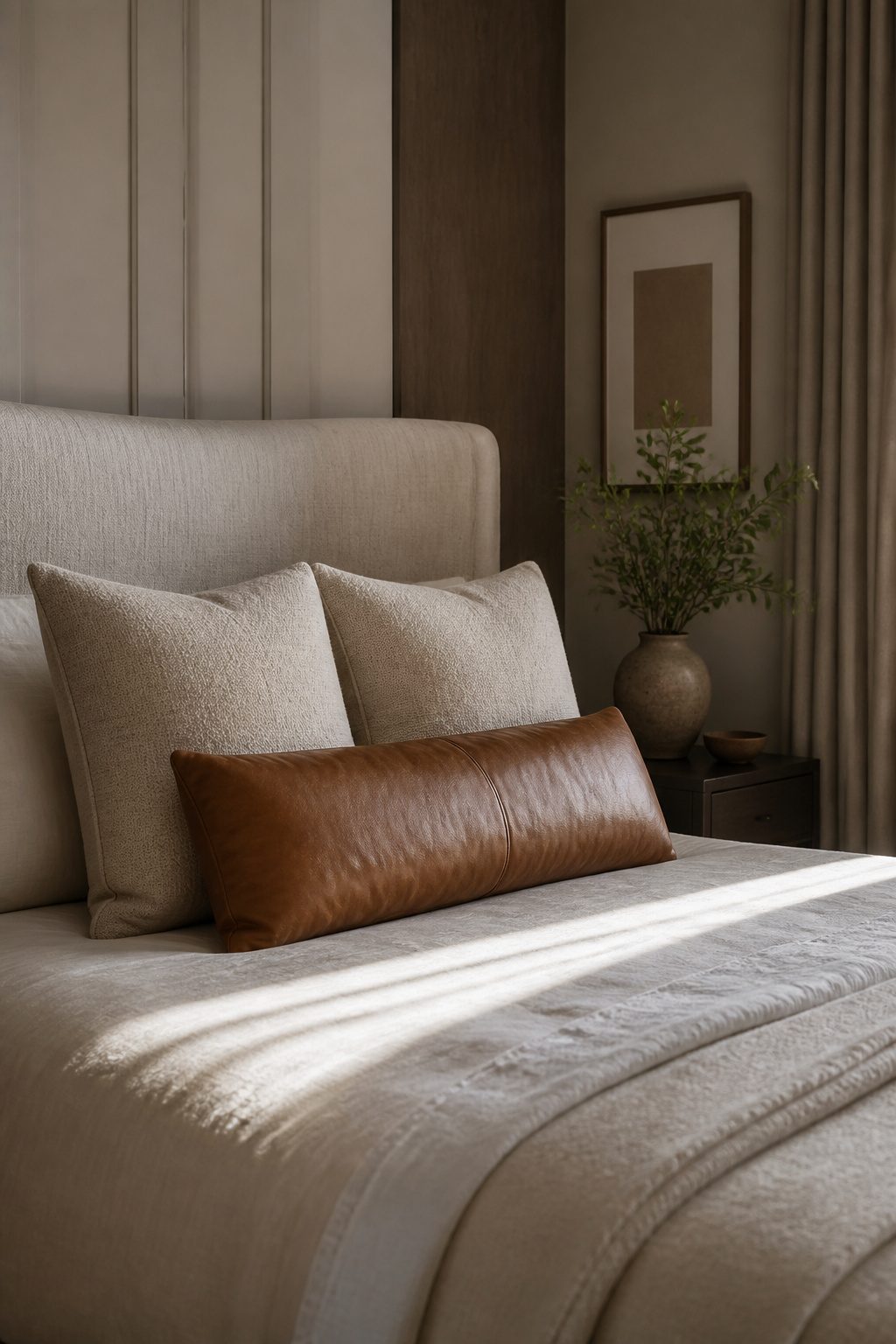
A leather lumbar pillow across the front of an otherwise soft arrangement does something prints and tassels never quite manage. It adds weight. The contrast reads as intention rather than decoration, especially against linen or cotton that has gone too uniform.
The formula is simple: two standard sleeping pillows leaned against the headboard, one large leather lumbar pulled across the front. For a queen bed, that three-pillow minimum keeps the sleeping space from feeling swallowed. On a king, the same lumbar still works, though the proportions of the back layer matter more.
Real leather at lumbar size runs steep for a weekend project. Faux leather from Amazon Basics or IKEA holds the look at roughly a third of the cost, and the difference is not obvious from across a bedroom. The vinyl-crack worry is real, but in a pillow that sees no body weight, it takes years to show.
What sold me on trying this was noticing how fast an all-soft bed goes flat in photographs. The leather gives the eye a place to stop. One rectangular accent with actual rigidity is enough to make the whole stack look considered rather than accumulated.
16. Sweet Simplicity
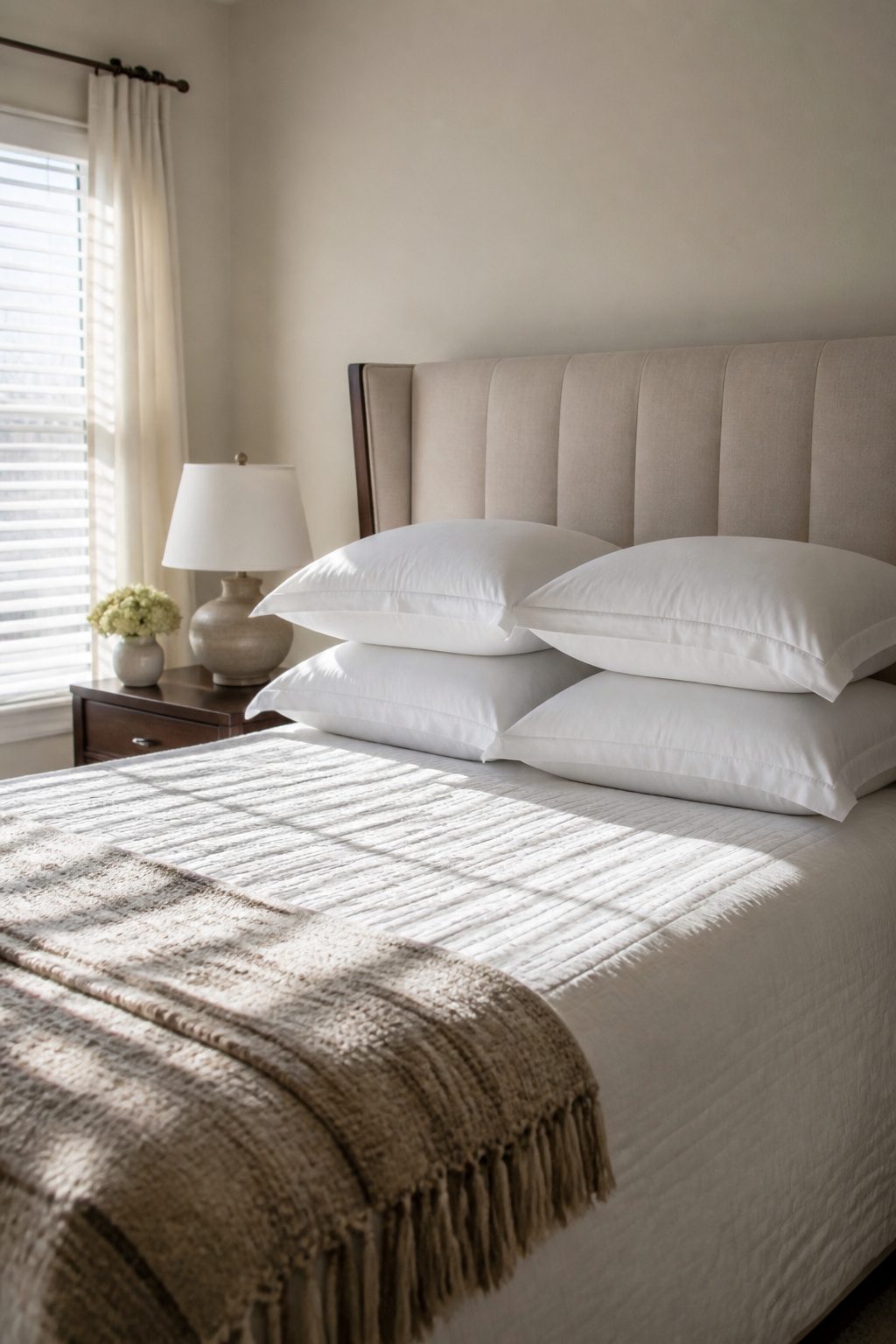
Four sleeping pillows stacked two by two is the arrangement that convinced me Instagram is wrong about needing more. Sometimes the bed just needs to look slept-in rather than staged.
The trick is in the stack itself. Two pillows laid flat, then two more centered on top so the edges offset by a couple inches. That slight step keeps it from reading like a laundry pile. Standard shams on top, regular cases below gives the cleanest finish; the flange on a sham frames the stack without adding another purchase.
I tried this in a guest room last year after pulling decorative pillows off every surface for washing day. The room looked finished anyway. For renters or anyone making the bed in a hurry, this is the one that survives real mornings: no propping, no fluffing artfully, no third layer to store somewhere by night. The bed is made when the pillows are stacked, full stop.
What it costs you is the decorative layer, and that matters in a room where the bedding itself is plain. If the sheets and cover read as texture or color, the pillow stack holds its own. If everything is flat white, you may want one of the fuller arrangements later in the list.
17. Solitary Standout
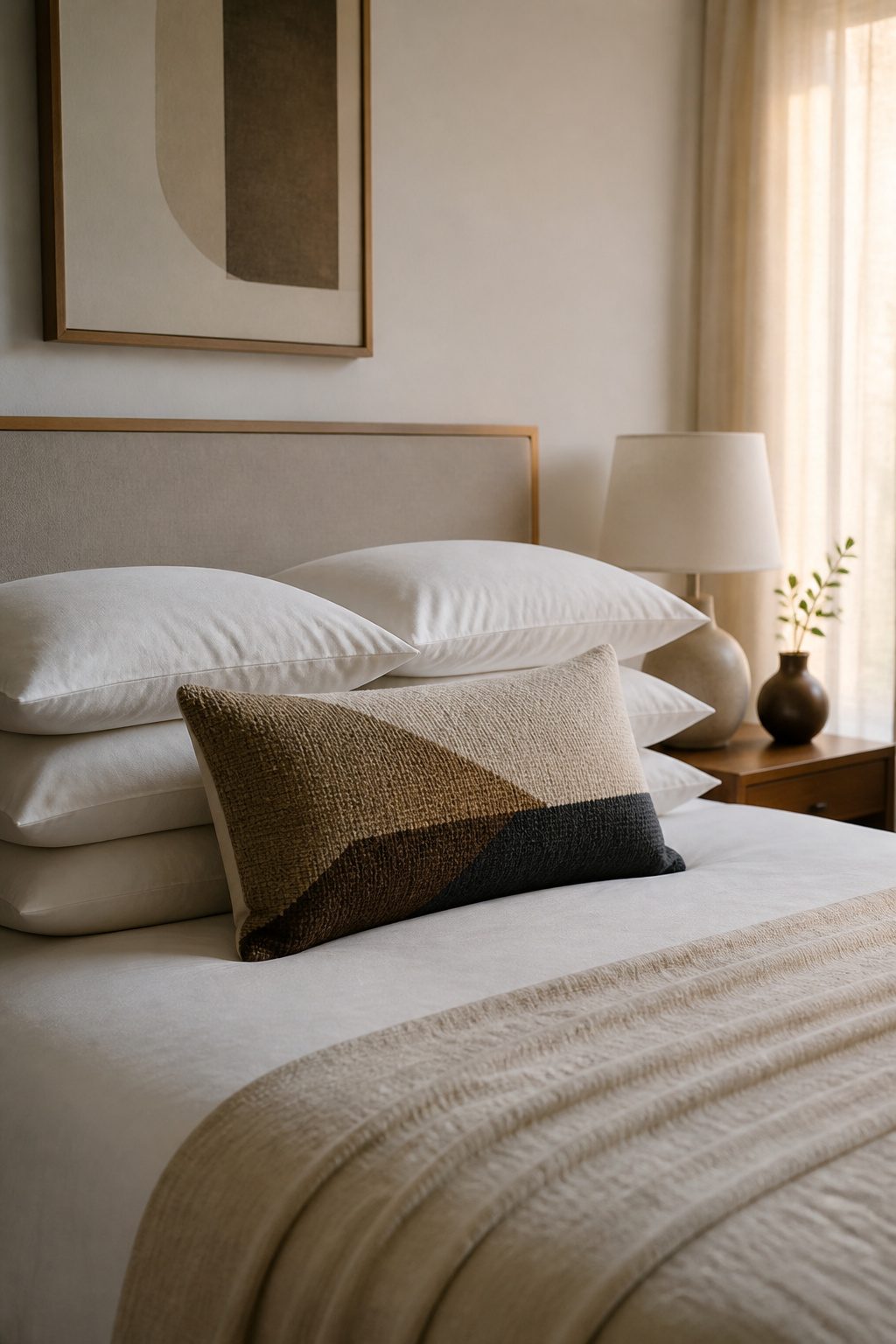
A single lumbar pillow, 12-by-18 inches or 14-by-36 inches, propped in front of stacked sleeping pillows does more visual work than three smaller accents fighting for attention. The narrow rectangle breaks up all those square edges without adding clutter.
Four standard sleeping pillows stacked against the headboard give you the height and structure; the lumbar sits in front as the one deliberate accent. Pattern or texture on that single piece reads as intentional, not accidental. Several small pillows tend to look like you kept adding until something stuck.
I learned this the hard way after swapping a cluster of 18-inch squares for one long lumbar. The bed looked finished instead of busy, and making it took half the time. For a twin bed, the same logic holds with one standard and one lumbar; anything larger, stick with two standards behind your single accent.
The lumbar can match your sheets for a quiet, pulled-together look or contrast for something more modern. Either way, one strong piece carries the whole arrangement.
18. All Propped Up
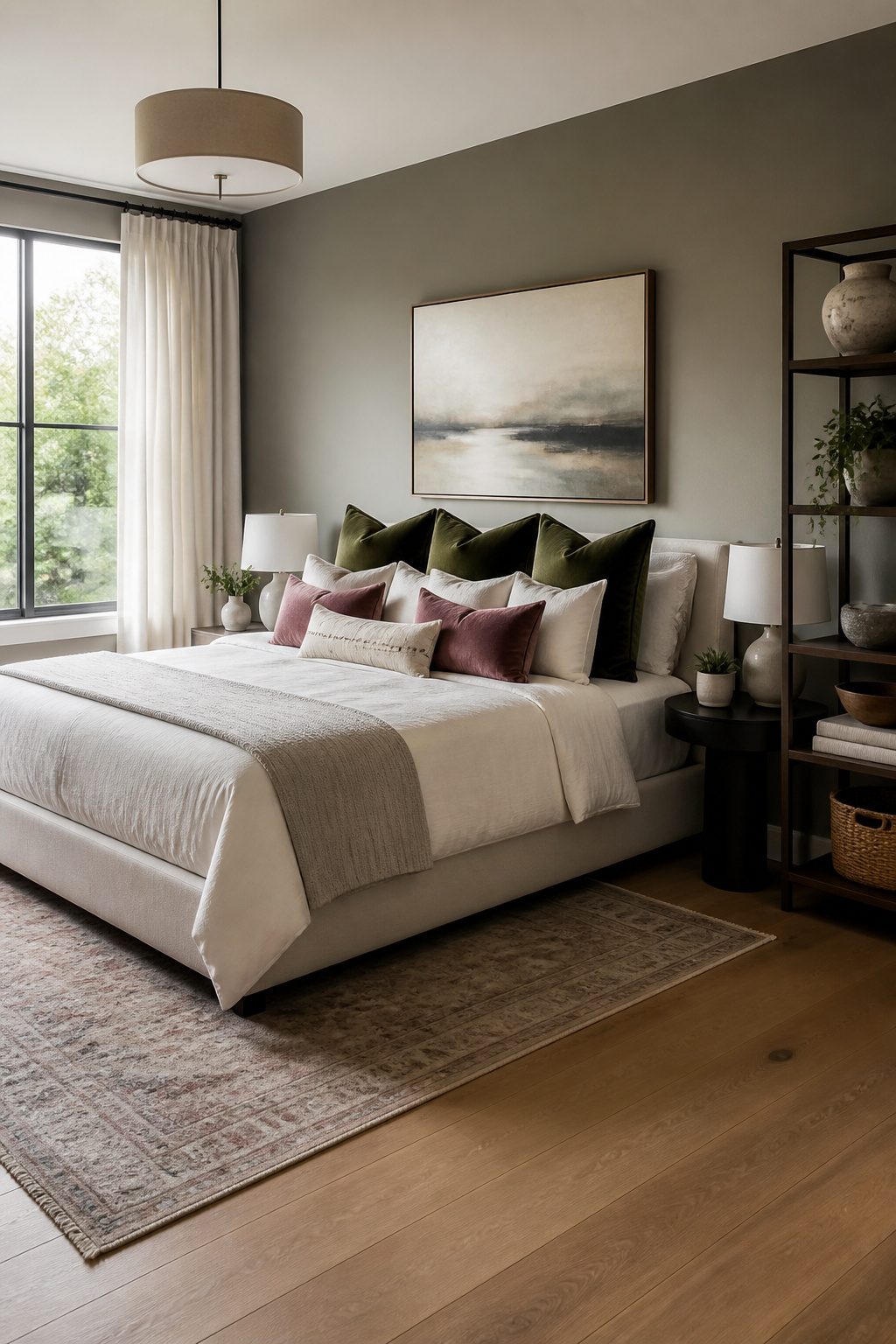
Leaning pillows against the headboard instead of stacking them builds a slope that reads as relaxed but still intentional. The back pillow sits at roughly forty-five degrees, the next one tilts slightly more forward, and the front one nearly meets the mattress, so the line travels rather than steps. Three to four pillows total is usually the limit before the slope collapses into clutter.
Effortless Minimalism keeps its angles lower and its count tighter, maybe two pillows total with a barely-there lean that nearly flattens. All Propped Up needs that steeper pitch and that extra layer to register as deliberate. The difference is the difference between a sofa someone threw a blanket on and a sofa someone arranged for you to sit in.
I tried this on a metal headboard once and the pillows slid to the gap behind the mattress by morning. A fabric headboard or a wall-mounted panel holds the angle better. Without something to grip, you are really just making a pile with extra steps.
19. Relaxed Refinement
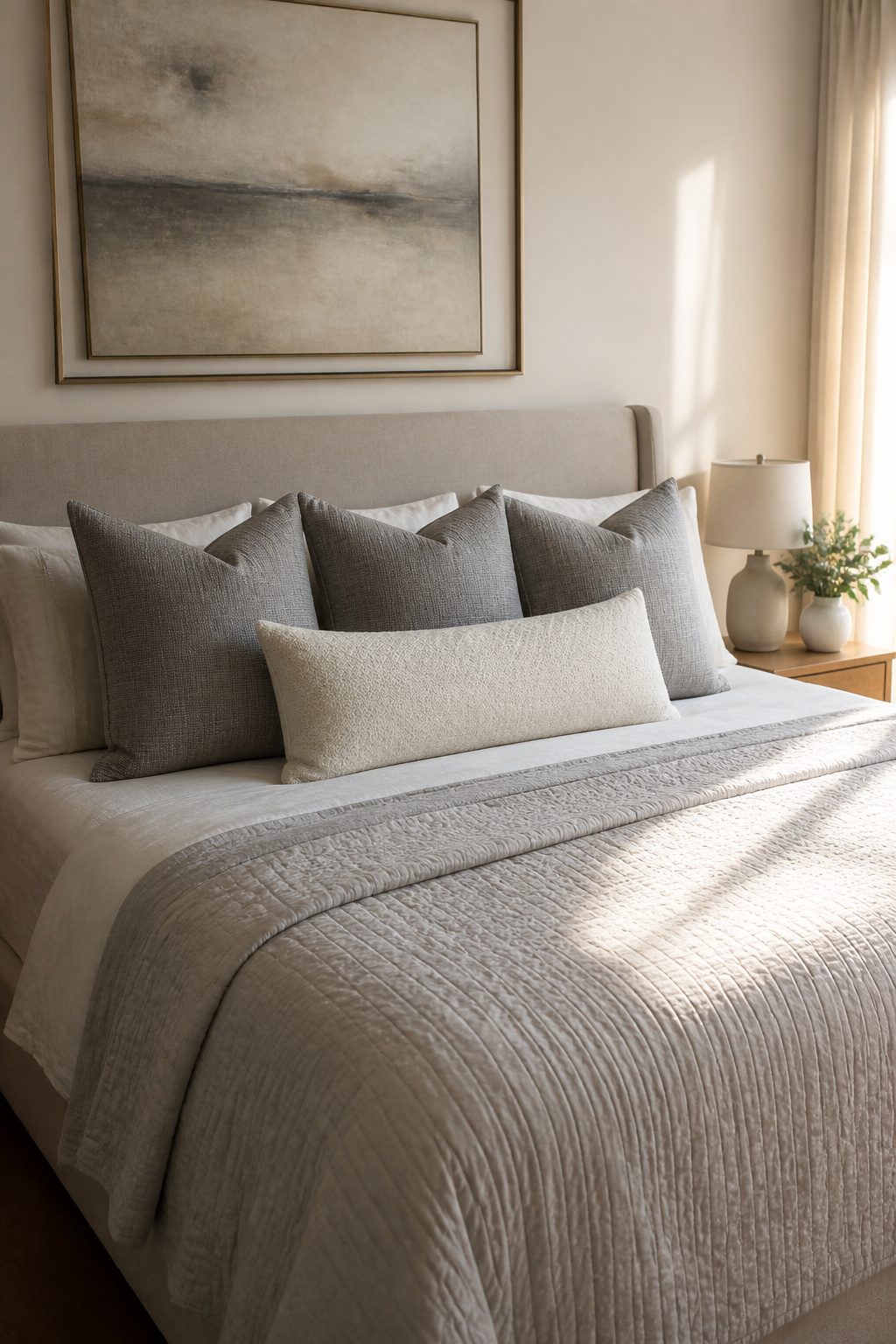
Three European shams across the back of a king bed fill the width without looking scattered, and the squared shape sits flatter than standard pillows so the stack stays tidy even when you lean against it. I tried this on a full bed once and it was a mistake: the shams overhung the edges by several inches and the whole thing looked like a shelf waiting to tip. A king needs three; a full or queen stops at two or the proportions turn heavy.
The depth works best with minimal layers in front. One designer I read keeps just a single lumbar pillow in front of the Euro row, which means only two pillows come off the bed at night instead of a whole parade. If you do want more layers, king-size sleeping pillows in shams sit well in the middle, but I would skip the third decorative row unless you genuinely use them for reading. The bed should look finished, not furnished.
20. Perfectly Imperfect
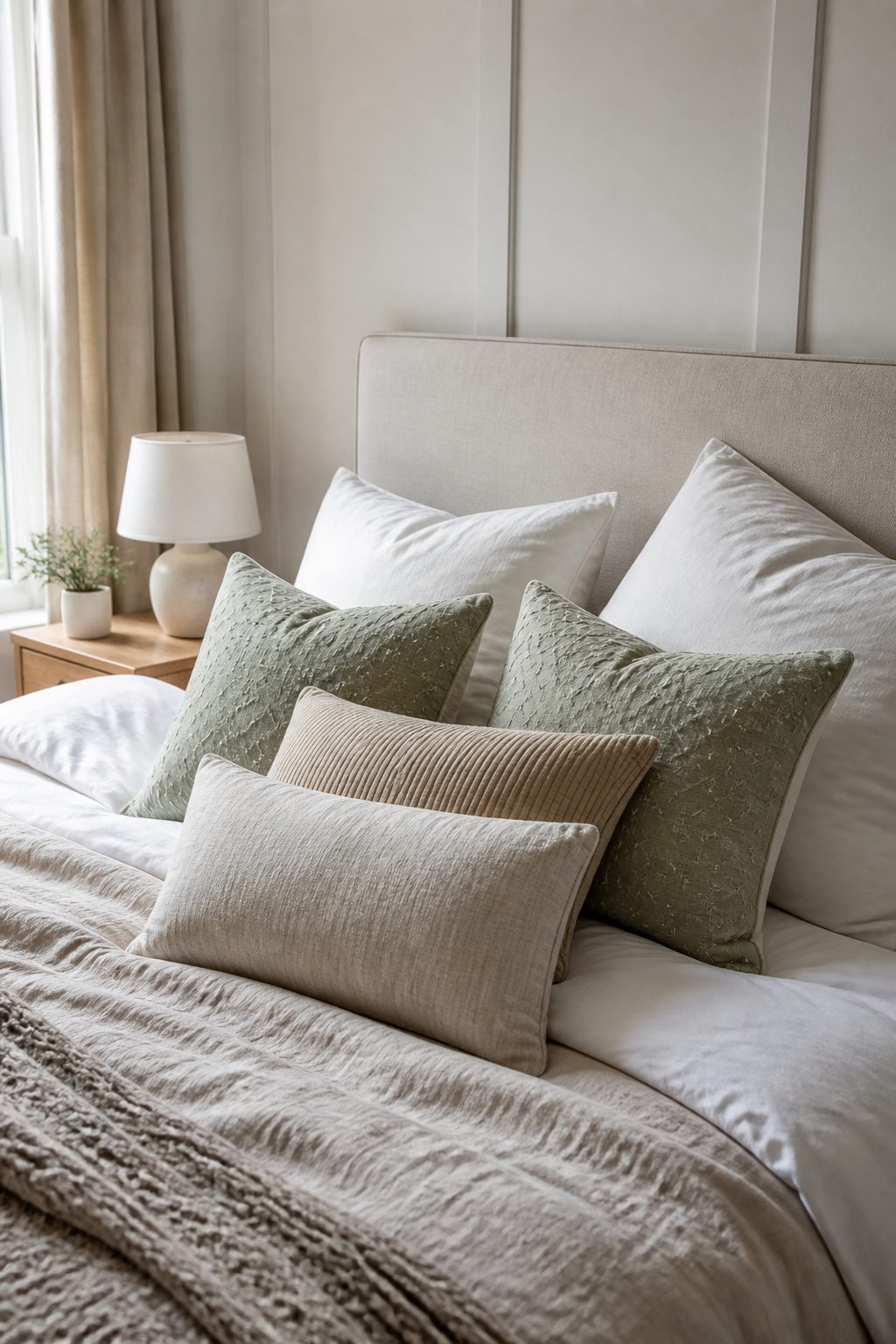
The perfectly imperfect look lives in the gap between staged and sloppy. Two standard sleeping pillows lean against the headboard, not propped to attention but settled at slightly different angles. Two matching throw pillows anchor the front, then two more in tonal colors land somewhere else entirely, maybe one kicked toward the foot, the other tucked against the side rail. The palette stays muted and complementary so the eye reads intention even when the placement refuses symmetry.
Odd numbers help the relaxed look; matched pairs hold the formal one. Start symmetrical, then remove or reposition one pillow until it feels like someone actually slept there and straightened up in a hurry. Asymmetry reads creative, not careless, when the colors already agree. Cross into messy when the fabrics fight or the pillows tumble into the walkway. Keep them on the bed, just not in line.
Pillow Sizes by Bed Type
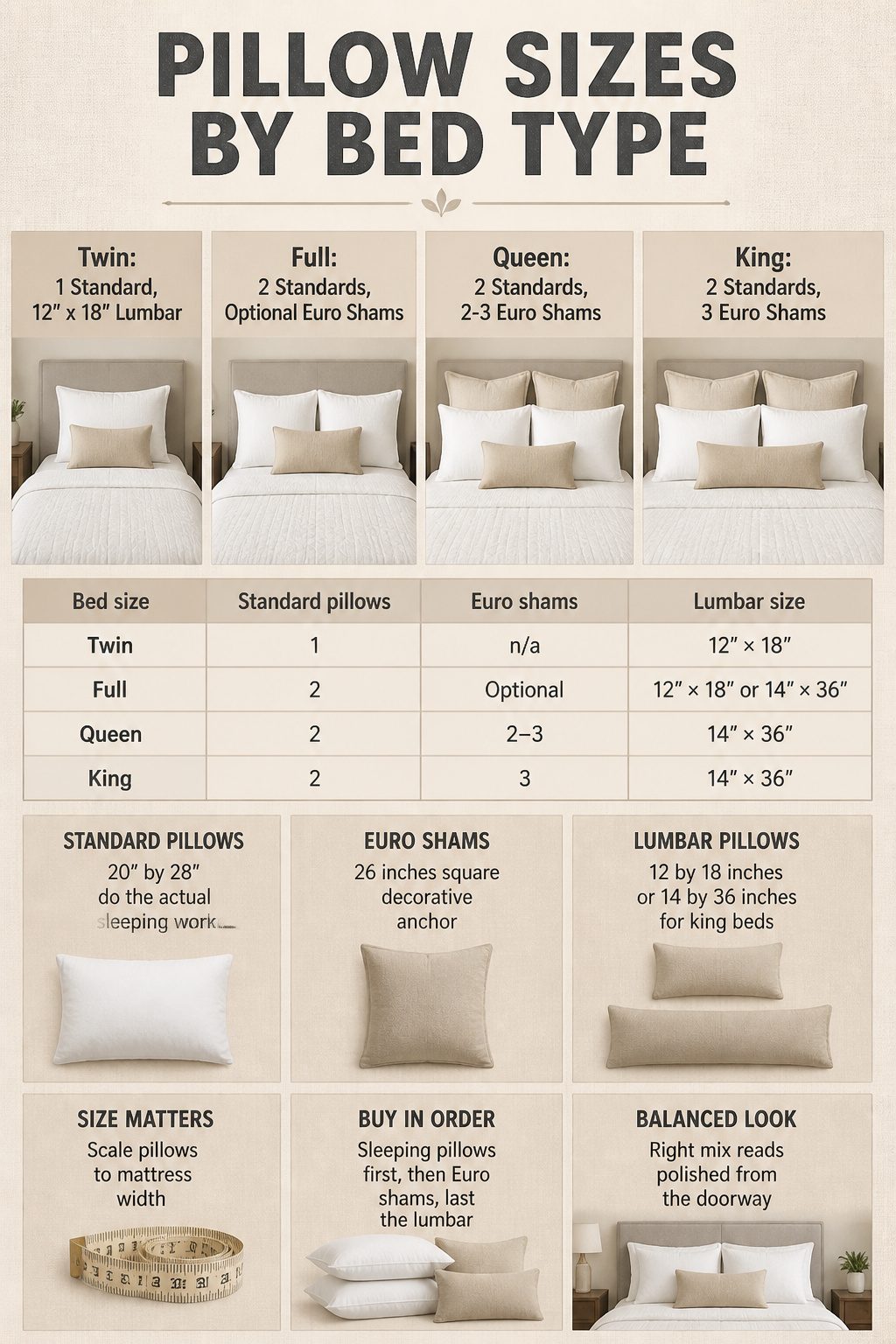
Standard pillows measure 20 inches by 28 inches and do the actual sleeping work, while Euro shams at 26 inches square sit upright against the headboard as the decorative anchor. Lumbar pillows finish the row, either at 12 by 18 inches or stretched to 14 by 36 inches for king beds.
I started building my own set with one of each and the bed looked lopsided until I checked the scale against the mattress width. A twin bed needs a single standard and one smaller lumbar. Full beds and up want two standards layered in front, with that lumbar centered last. For king beds, three Euro shams across the back with a 14-by-36 lumbar in front gives the full, polished look that actually reads balanced from the doorway.
| Bed size | Standard pillows | Euro shams | Lumbar size |
|---|---|---|---|
| Twin | 1 | n/a | 12" × 18" |
| Full | 2 | Optional | 12" × 18" or 14" × 36" |
| Queen | 2 | 2–3 | 14" × 36" |
| King | 2 | 3 | 14" × 36" |
Buy the sleeping pillows first, since you will use them every night whether the arrangement is styled or not. Add the Euro shams next if you want that upright hotel look against the headboard. The lumbar is the last piece and the easiest to swap when the seasons change.
Layering from Back to Front
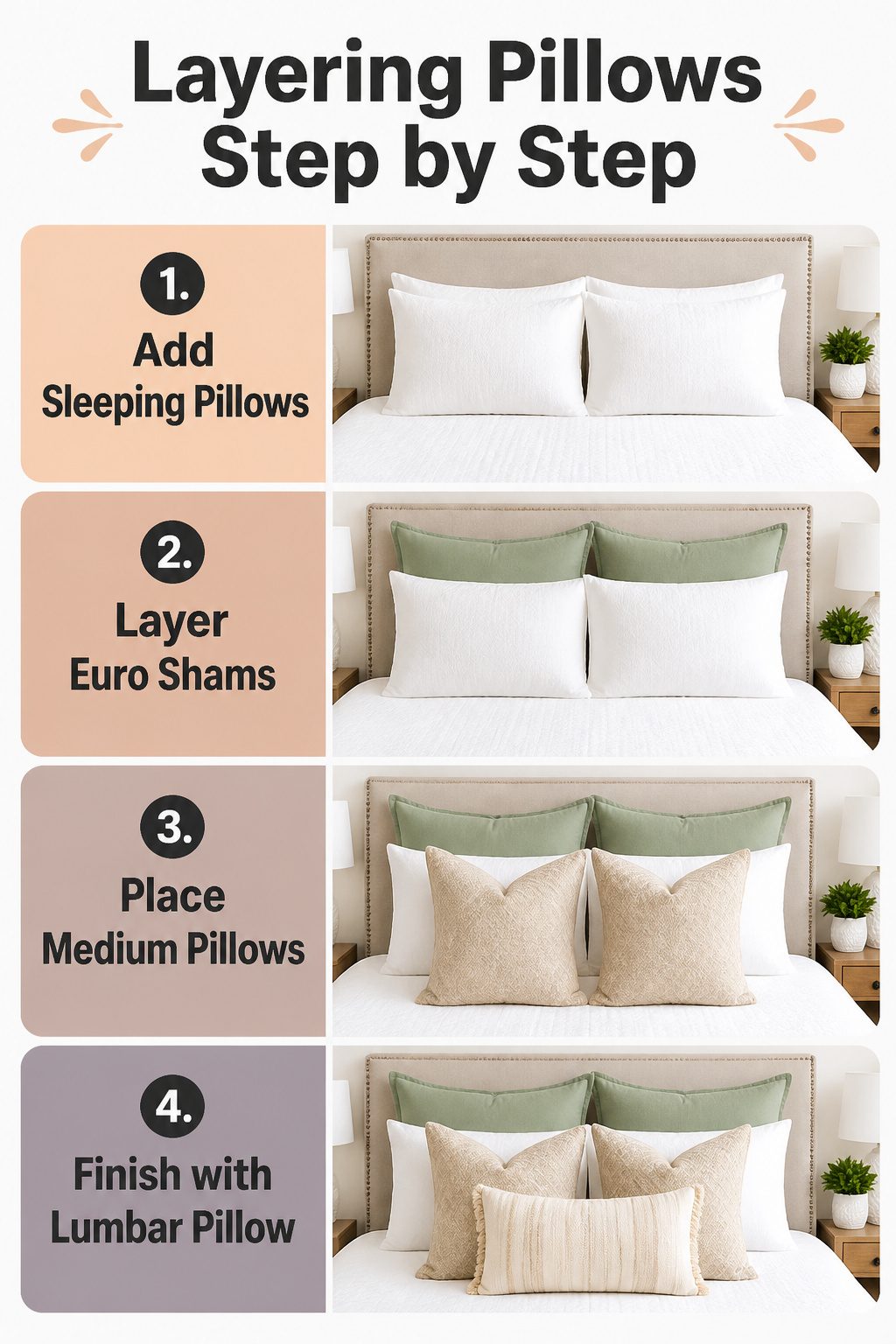
Prop the largest pillows upright against the headboard, then set each smaller row in front so every edge stays readable. Sleeping pillows go first, then euro shams or 26-inch squares, medium 22-to-24-inch pillows, and a lumbar or small accent in front. The sequence works because nothing hides behind anything else; you see color and texture at every step.
For a queen, three to five decorative pillows is the useful ceiling. For a king, five to seven. A guest bed or everyday setup can stop at two squares and one lumbar without looking unfinished.
Break the order when you want one piece to pull focus. A patterned 20-inch pillow reads louder centered in front than buried in the stack, and a single lumbar shoved between two medium squares creates a gap that draws the eye. I keep the sizes descending for calm and interrupt them when the bed needs something to look at.
Color, Texture, and What Matches
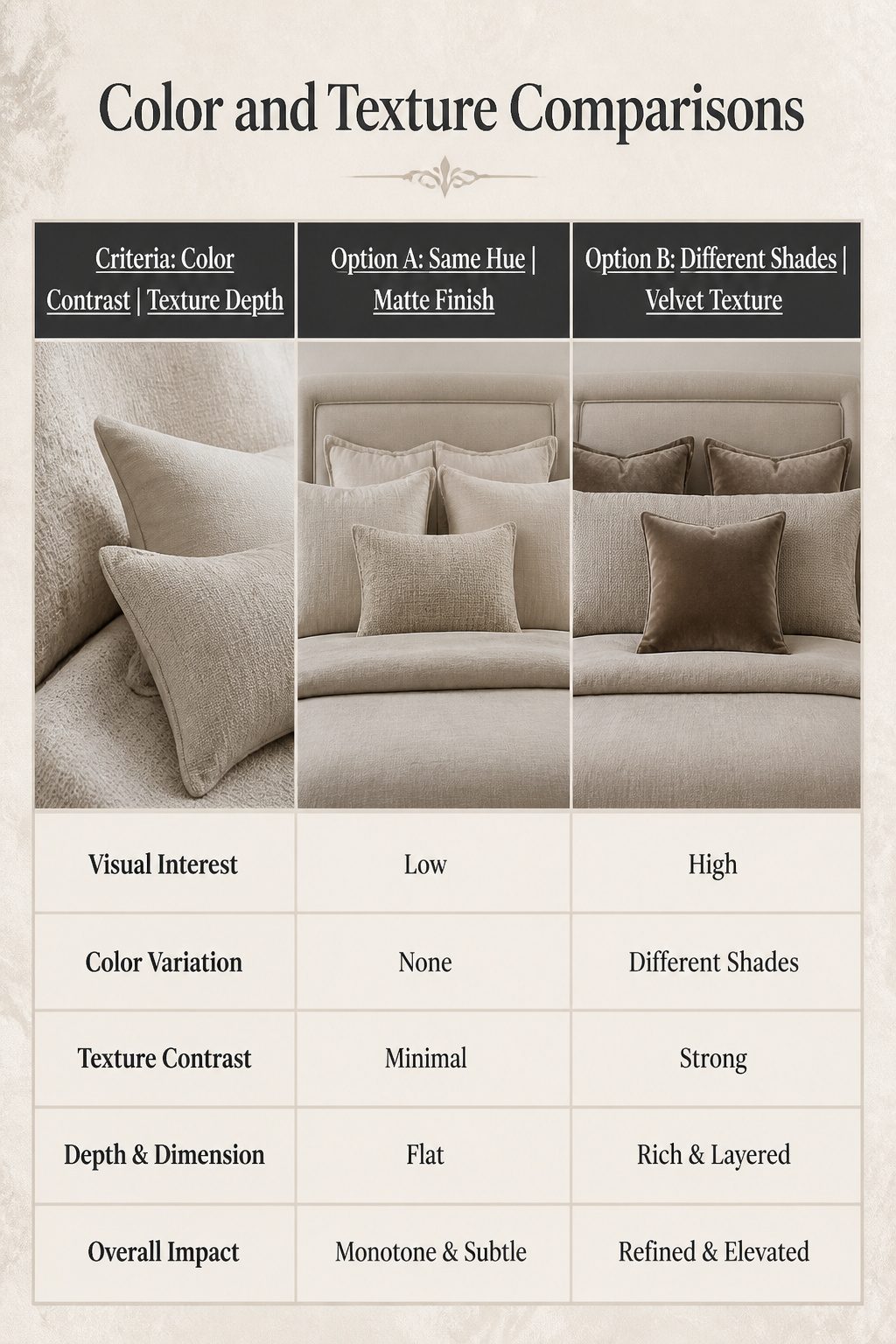
Throw pillows that mirror the bedding exactly tend to flatten a bed into one visual plane, so a slight contrast in color, pattern, or texture reads far more intentional. Same color family, different finish, is usually the safer move. A matte linen sham against a sateen duvet, or a velvet cushion in a deeper tone of the same hue, gives the eye something to travel to.
For entry-level budgets, mix cotton weaves, linen, and a single velvet rather than buying all-new everything. A metallic-toned velvet in gold or champagne against quiet neutrals adds shine without tipping into flashy, and one of those carries more weight than three cheap prints. If you are working monochrome, tactile depth is not optional; it is what keeps the bed from reading as a blank slab. Two standard sleeping pillows propped vertically, two Euro shams to cover the width, and a front layer of one or two 18-inch squares in a contrasting texture will usually do it. Stay inside one color family, but let the fabrics disagree enough that you notice them separately.
Symmetry Against Asymmetry
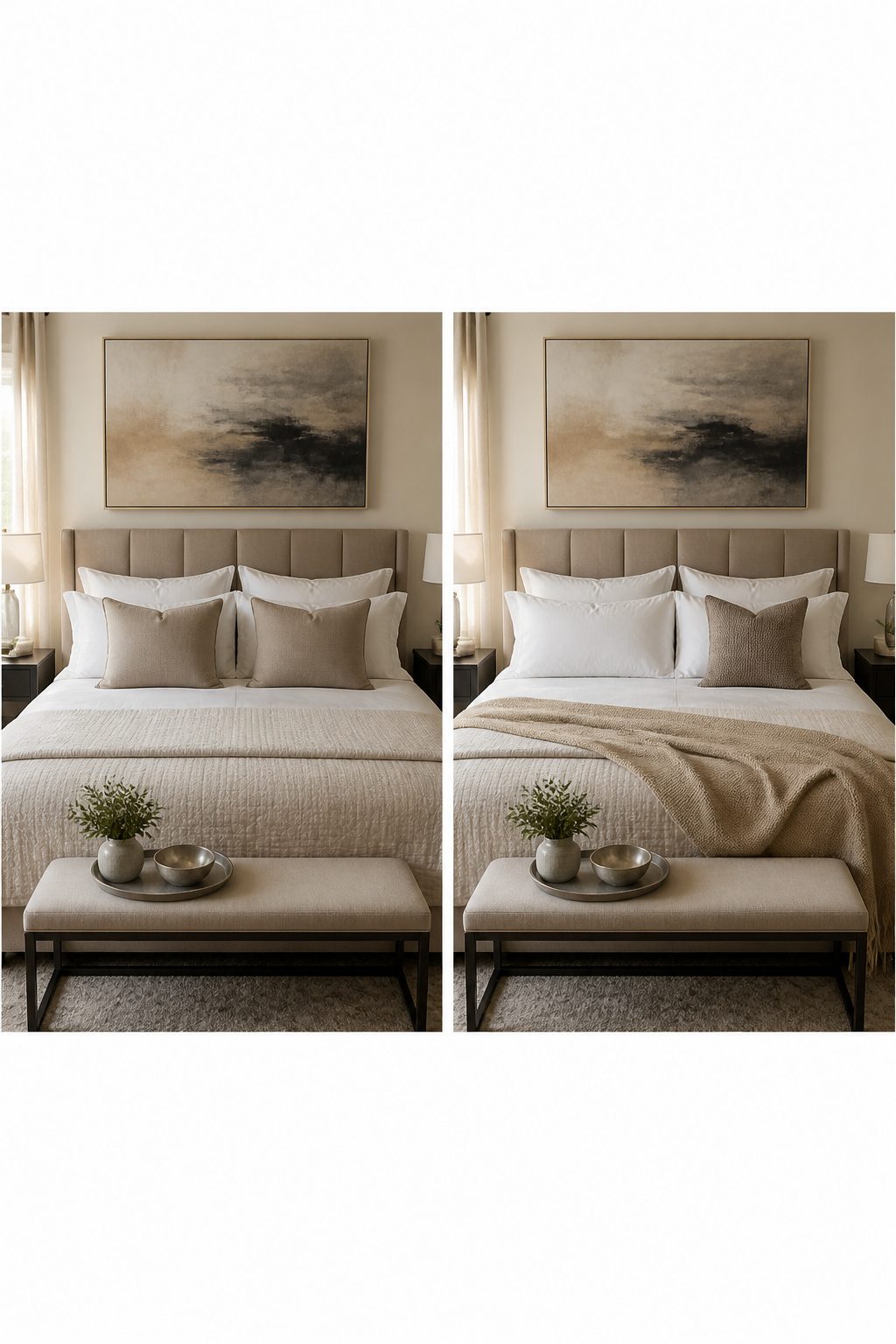
A king-size bed can swallow a pillow arrangement whole, so the first choice is whether to mirror everything or let it drift. Symmetry reads neat and classic; asymmetry reads creative and relaxed. The easy path is to start matched, stack your four sleeping pillows in two pairs, add two Euro shams side by side, then pull one forward or swap it for a tonal scatter so the bed looks slept-in rather than staged.
For a full-nine-pillow formal look, keep the pairs strict: four standards, two Euros, two 20-inch squares, one lumbar dead center. That width needs a tall headboard to hold the vertical line; without one, the back row slumps unless the bed sits against a wall.
Odd numbers break the formality without losing intention. Two standard pillows leaned at slightly different angles, two matching throws plus two more in related colors placed deliberately off-center, give the relaxed effect that still reads as a choice, not a mess. The palette does the unifying work when the geometry won’t.
How many pillows you’re willing to move at bedtime settles it faster than any rule. Full symmetry costs you more removals; asymmetry often starts with fewer and builds forward.
Living With Decorative Pillows
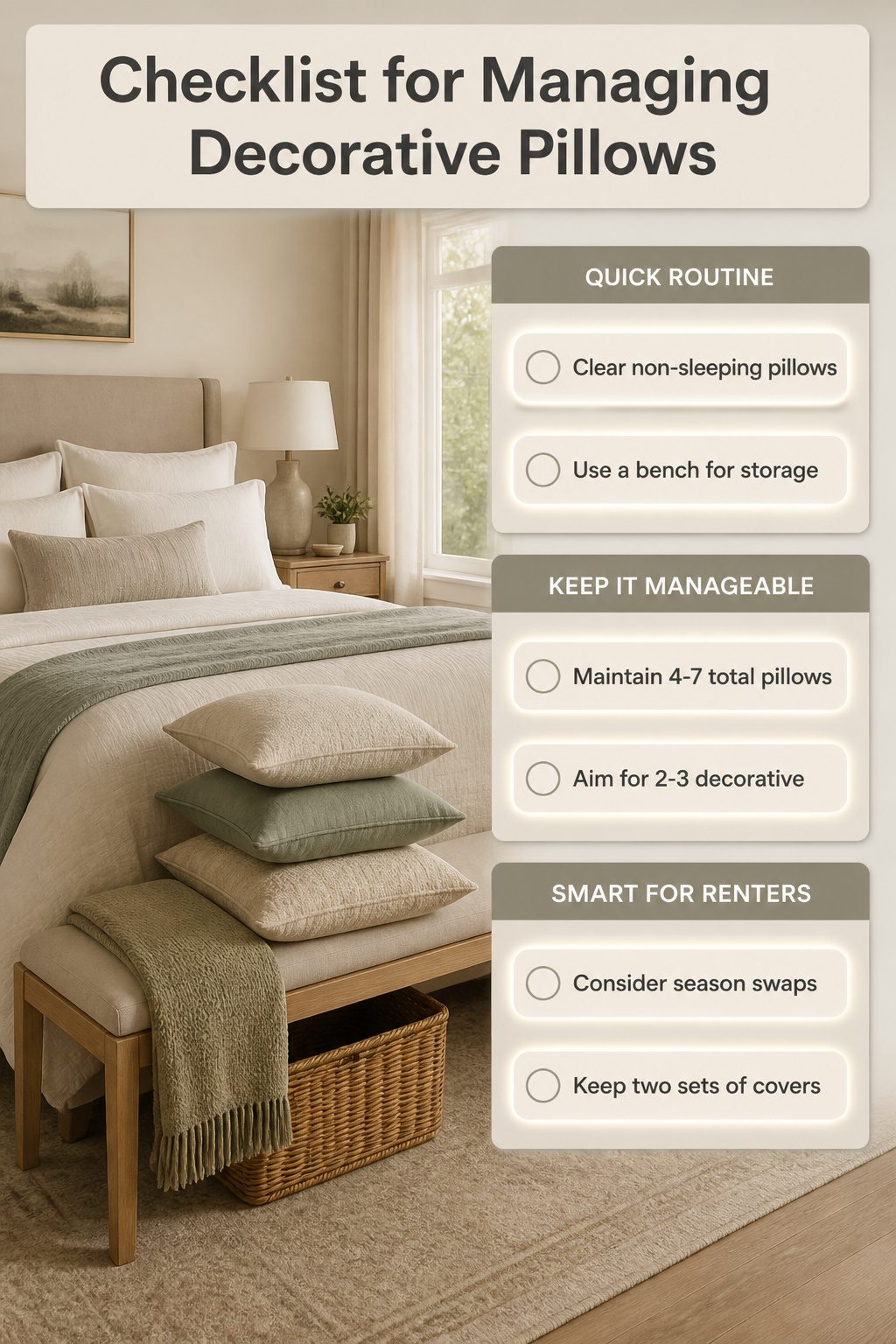
The sleeping pillows stay; everything else comes off. Euro shams, throws, and the lumbar in front all get cleared in under thirty seconds, which is about how long the practical sources say it takes. Where they land depends on what your room allows.
- A bench at the foot of the bed is the first place to look. Decorative pillows stack there until morning, still within reach but off the mattress.
- A basket on the floor nearby works if the bed is against a wall and a bench won’t fit. The key is having a spot you actually use, not a theoretical one that leaves pillows on a chair by Tuesday.
- For a queen bed, four sleeping pillows plus two or three decorative ones is the manageable ceiling. A king can take five to seven, but that is the point where the nightly removal starts to feel like a chore you skip.
- Renters without extra closet space should skip the seasonal rotation fantasy. Keep neutral base pillows year-round and swap covers instead. Two sets, changed out twice a year, store flat in the same basket the pillows sit in at night.
Frequently Asked Questions
How many pillows should you have on a bed?
A standard bed looks finished with four sleeping pillows plus two to three decorative accents. Keep it to two sleeping pillows and one throw if you prefer a minimal look, or build up to six or nine layered pieces if you want a fuller, more styled appearance. The exact count depends on your mattress size and how much surface you want to leave clear.
What size throw pillows look best on a bed?
Twenty- and 22-inch square pillows are the most versatile sizes for beds, filling width without crowding. Add a long lumbar pillow in front to break up the grid of square edges and give the arrangement a focal point. Queen beds do well with three to five decorative pillows total; kings handle five to seven.
Should the throw pillows match the bedding?
They do not need to match exactly. A slight contrast in color, pattern, or texture looks more intentional than everything coordinated. The article notes that keeping accents within one color family, say soft sky blues through deep navy, lets mismatched sizes and prints read as design rather than clutter.
How do you arrange pillows on a king bed?
Start with two king sleeping pillows side by side against the headboard, then stand two or three Euro shams upright in front of them. Layer two 22-inch square accent pillows next, and finish with a long lumbar at the front edge. The article points out that kings need five to seven decorative pillows to keep proportions from looking sparse against the wider mattress.
Do you have to take all those pillows off at night?
Only the decorative pillows come off; the sleeping pillows stay where they are. The article suggests keeping a basket at the foot of the bed for the decorative layer, though Euro-size front pillows on a king can simply be stacked flat and out of the way. This is one reason designer Caitlin Peltier prefers three Euro shams plus a lumbar, to keep the pillow count manageable.
Leave a Reply